Debt Avalanche Method Canada: Pay Off Debt Faster Step by Step

June 13, 2026
A beginner-friendly Canadian guide to the debt avalanche method with exact steps, examples, common mistakes, and links to payoff and budget tools.

DEBT PAYOFF
Pay the highest-interest debt first.
The debt avalanche method is a practical way to reduce interest and make each payment work harder.
- List debts by interest rate.
- Protect every minimum payment.
- Send extra money to the highest-rate balance first.
Run your debt numbers
Use this as a starting point, then adjust the numbers and timing to your own situation.
What's on this page
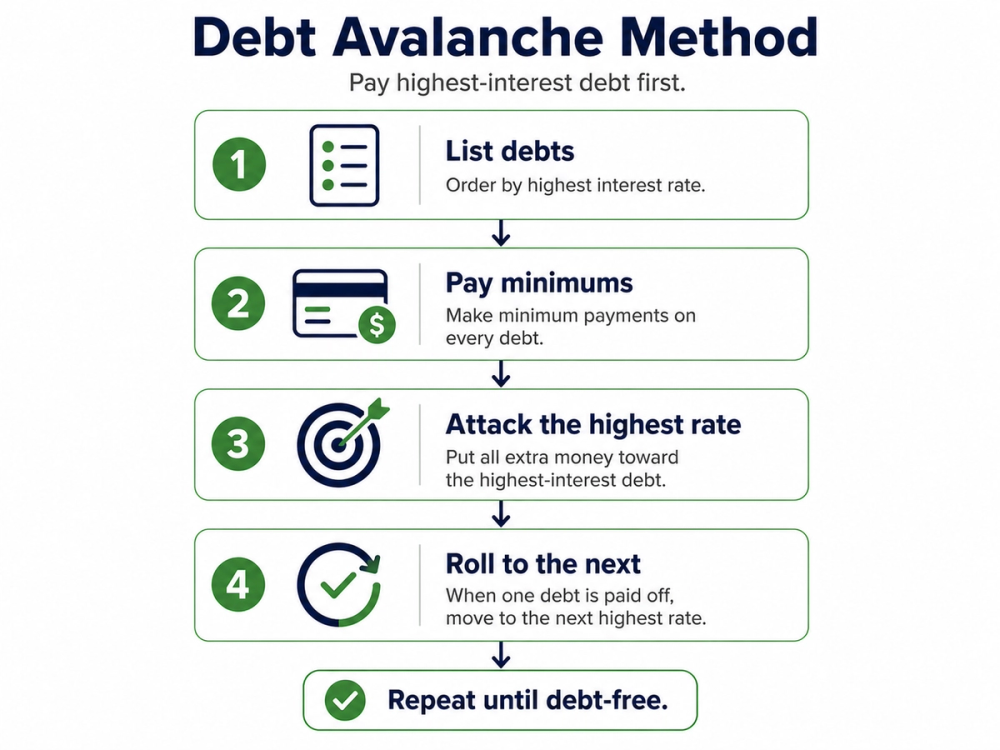
Pay the minimum on every debt, then send every extra dollar to the highest interest rate first. When that debt is gone, roll the payment into the next highest rate.
The debt avalanche method is simple: you pay the minimum on every debt, then put every extra dollar toward the debt with the highest interest rate. When that debt is gone, you move the whole payment to the next highest rate. You keep doing that until the debts are gone.
Do the math first
Before you choose a payoff amount, list your real balances and see what your monthly cash flow can handle.
Beginner version: what you do this week
- Open every account and write down the numbers. You need the balance, interest rate, minimum payment, due date, and whether the rate is temporary. Do not guess. Use the statement or online banking.
- Put the debts in interest-rate order. The highest interest rate goes at the top. A 21.99% credit card normally comes before a 9% line of credit, even if the line of credit balance is bigger.
- Turn on minimum payments. Set automatic minimum payments if you can. The avalanche only works if every account stays current. A late payment can add fees and hurt your credit.
- Choose one extra payment amount. If your budget says you can safely send $250 extra per month, that whole $250 goes to the top debt. Not $50 here, $70 there, and a bit somewhere else.
- Pay the top debt after every payday. Do not wait until the end of the month if money tends to disappear. Pay the extra amount when income arrives.
- When the first debt is gone, keep the payment alive. If the card minimum was $120 and you were adding $250 extra, you now send $370 to the next debt. That is where the method starts to move faster.
A simple example
Debt avalanche order
The credit card is first because it has the highest rate.
| Debt | Balance | Interest rate | Minimum | Avalanche order |
|---|---|---|---|---|
| Credit card | $4,200 | 21.99% | $120 | 1 |
| Store card | $1,100 | 19.99% | $35 | 2 |
| Line of credit | $8,500 | 9.45% | $90 | 3 |
| Car loan | $18,000 | 6.99% | $420 | 4 |
| Student loan | $15,000 | Fixed or prime-based | $170 | 5 |
Suppose the minimum payments add up to $835 and your budget gives you $250 extra. You would pay $835 in minimums, then send the extra $250 to the credit card. When the credit card is paid off, the $120 minimum and the $250 extra move to the store card. That is $370 going to the next target while all other minimums continue.
Why interest rate matters
Interest is the price of carrying the debt. A credit card at 21.99% is charging you much more than a loan at 6.99%. The avalanche method attacks the most expensive debt first, so more of your future payments go toward reducing balances instead of feeding interest.
If you want to see the difference, run the same balances in the debt payoff calculator twice: once with the highest-rate debt first, then again with the smallest balance first. The avalanche usually wins on total interest.
What to pay first if two debts have similar rates
- If rates are almost the same, choose the smaller balance first. That gives you a quicker win without giving up much interest savings.
- If one rate is promotional, check the expiry date. A 0% balance transfer that jumps to 22% in two months may need attention before a 12% loan.
- If one debt is overdue, fix that first. Collections, court risk, service cutoffs, or missed housing payments are urgent even when the rate is not the highest.
Avalanche vs snowball
- Debt avalanche: highest interest rate first. Best when you want the lowest interest cost.
- Debt snowball: smallest balance first. Best when quick wins keep you moving.
- Hybrid: clear one tiny balance for momentum, then switch to the avalanche. This is fine if it helps you stick with the plan.
Common mistakes
- Paying extra everywhere. It feels productive, but it slows the top target. Pick one debt.
- Ignoring minimums. Never skip minimums to make a bigger payment somewhere else.
- Using the card again. If the credit card is the target, stop adding new purchases to it unless you can pay them off immediately.
- Forgetting annual fees and bills. Car insurance, gifts, vet bills, school fees, and travel can push you back into debt if you do not save for them monthly.
- No emergency buffer. Even $500 to $1,000 in a separate account can prevent one surprise from going back on the card.
A practical payment routine
- Pay rent, food, transit, insurance, utilities, and minimum debt payments first.
- Move a small amount to emergency savings if the account is empty.
- Send the planned extra payment to the highest-rate debt after each payday.
- Update your balance list once a month.
- When a debt hits zero, move its old payment to the next debt before you get used to spending it.
This is easier when your monthly plan is visible. Use the monthly budget planner to find an extra payment that is aggressive but still realistic.
When the avalanche is not the first move
- You are behind on rent, mortgage, utilities, child support, taxes, or an account with legal consequences.
- You have no money left for food or transit after minimums.
- You have no small emergency buffer and every surprise goes back on the credit card.
- A lender offered a hardship plan, lower rate, or formal repayment option that changes the math.
Bottom line
The debt avalanche method works because it removes debate. You keep accounts current, attack the highest rate, and repeat until the list is gone. It is not fancy. That is the point.
Related articles:
Page details
Author: Thomas Tremblay
Updated: June 13, 2026
Last reviewed: June 13, 2026
Cite this page: Canooq.ca, Debt Avalanche Method Canada: Pay Off Debt Faster Step by Step, https://www.canooq.ca/blog/debt-avalanche-pay-off-debt-faster-canada
Canooq content is educational and may include affiliate or referral links. It is not financial, tax, legal, immigration, employment, mortgage, real estate, or healthcare advice. Verify official sources and provider terms before acting.
Enjoy Canooq? Let us keep helping you — make Canooq a preferred source on Google.