How Credit Scores Work in Canada: The Complete Beginner's Guide

June 15, 2026
A complete beginner guide to how credit scores work in Canada, what improves them, what hurts them, and how newcomers can build credit.
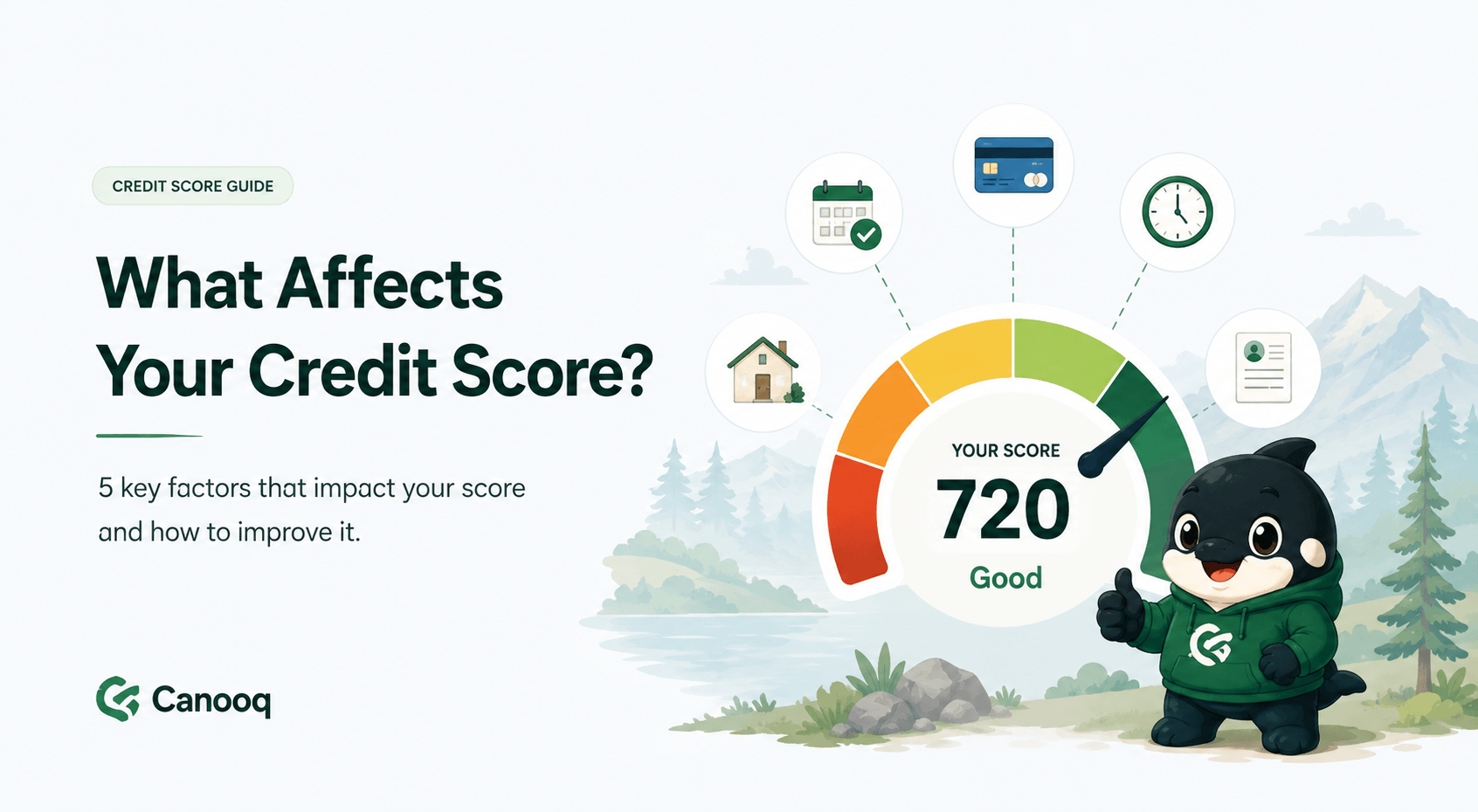
What's on this page
Learn what a Canadian credit score is, what lenders use it for, how to improve it, how to recover from bad credit, and how newcomers can start from no Canadian history.
Credit Score Guide
How credit scores work in Canada, from the first account to a strong file.
Your score is a shortcut built from credit-report information. Lenders use it with your income, debt, documents, and application details when deciding whether to approve you and what terms to offer.
- Canadian credit scores usually run from 300 to 900.
- Equifax and TransUnion are the two main credit bureaus in Canada.
- Payment history, balances, account age, hard checks, and credit mix affect your score.
- Checking your own score is a soft check and does not lower it.
Test the habits that move a score
Use it to understand habits, not to predict an exact bureau score.
Introduction
A credit score is a number based on the information in your credit report. In Canada, it can affect whether you get approved for a credit card, car loan, apartment, phone plan, line of credit, or mortgage. It can also affect the interest rate, limit, deposit, or paperwork a lender asks for.
Most adults in Canada should care because credit touches ordinary life. You may not borrow much today, but a clean credit file can make future housing, financing, and emergency decisions less expensive.
Newcomers often start with little or no Canadian credit history. That is not the same as bad credit. It means Equifax and TransUnion may not have enough Canadian information yet to score you confidently. You build the file with Canadian credit activity.
Understanding credit early saves money because you can avoid late payments, high balances, rushed applications, and avoidable interest. This guide covers the full A-to-Z path: what a score is, what it is used for, what improves it, what hurts it, how to recover from a low score, and how to build credit in Canada from scratch.
What is a credit score?
A credit score is a three-digit estimate of credit risk. In plain language, it tries to predict how likely you are to repay borrowed money on time based on your past credit behaviour.
Canadian consumer credit scores commonly run from 300 to 900. Higher is stronger. A higher score does not guarantee approval, and a lower score does not mean every lender will say no, but the score gives lenders a fast first read.
- Equifax and TransUnion are the two main Canadian credit bureaus. They collect credit-report information from banks, card issuers, lenders, collection agencies, courts, and other reporting organizations.
- Your credit report is the file. It can include credit cards, loans, lines of credit, mortgages, payment history, credit limits, balances, collections, public records, and inquiries.
- Your credit score is the number based on that file. Different scoring models can read the same file in different ways.
- Lenders may see more than the number. They can review payment history, balances, recent applications, collections, bankruptcies, income, debt, documents, and their own approval rules.
Your Equifax score and TransUnion score may not match. One bureau may have newer information, a lender may report to one bureau before the other, and the scoring model may weigh details differently. Do not obsess over a small difference. Focus on the habits inside the report.
What is a credit score used for in Canada?
A credit score helps organizations decide how risky it feels to lend to you, bill you later, rent to you, or give you access to a product without a large deposit. The score rarely works alone. Income, identity, employment, debt, rent, down payment, and documents can matter too.
- Credit cards. Issuers may use your score and report to decide approval, credit limit, interest rate, card tier, and whether you qualify for a welcome bonus.
- Loans and lines of credit. A stronger score can make approval easier and pricing better, especially when income and debt also look stable.
- Mortgages. Mortgage lenders look at credit, but they also care about income, down payment, property value, employment, debt ratios, and documentation. A good score helps. It does not replace affordability.
- Car financing. A weak credit file can mean a higher rate, a bigger down payment, or fewer lender options.
- Apartment rentals. Some landlords or property managers run credit checks. They may care about unpaid debts, collections, or a pattern of missed payments more than one exact number.
- Some jobs. Certain roles may involve credit checks, especially jobs connected to money, security, or trust. Employers need to follow applicable rules and consent requirements.
- Phone plans and utilities. Providers may check credit before approving postpaid service or may ask for a deposit when your file is thin.
- Insurance in some cases. Rules vary by province and product. Credit information can matter in some insurance contexts, but it is not universal.
What improves your credit score?
No trick improves a score more reliably than boring consistency. You want the credit bureaus to see that you pay on time, avoid using too much of your limit, keep useful accounts open, and apply for credit with purpose.
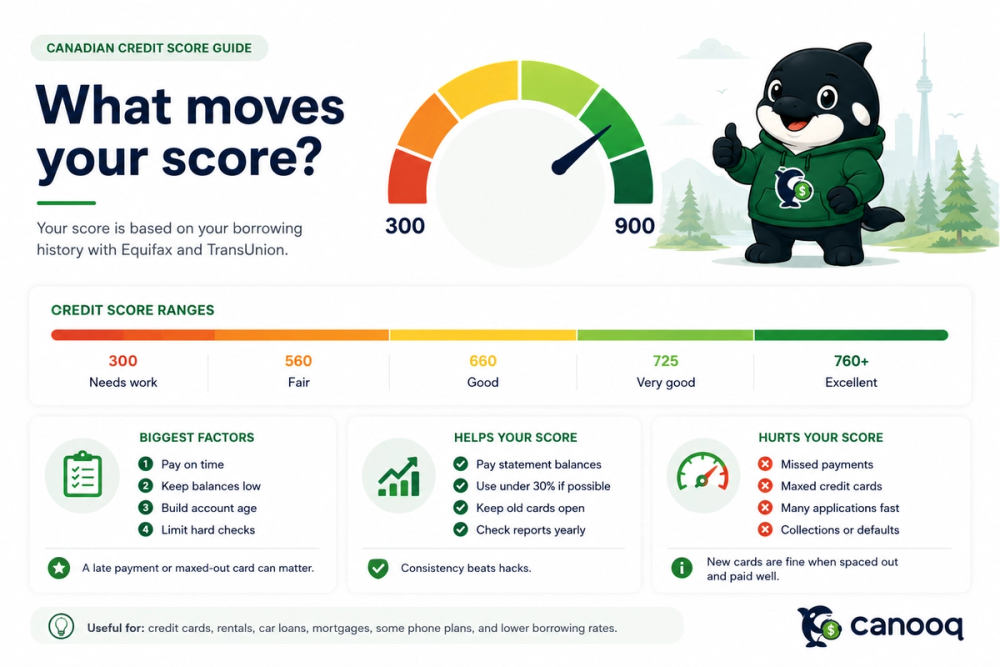
- Pay every bill on time. Payment history usually matters the most. If you cannot pay the full balance, make at least the minimum payment before the due date.
- Keep utilization low. Utilization means how much of your available credit you use. If you have a $1,000 limit and report a $700 balance, your utilization is 70%. Lower is usually better. FCAC points to using less than 30% of available credit where possible.
- Let older accounts age. A longer history gives lenders more evidence. A no-fee older card can be useful if you can keep it safe and pay it on time.
- Limit hard inquiries. A hard inquiry happens when you apply for credit and a lender checks your report. A few applications are normal. Many applications in a short period can hurt.
- Use a healthy mix of credit only when it fits your life. A credit card, line of credit, car loan, student loan, or mortgage can show different repayment patterns. Do not borrow money just to create a mix.
You can improve credit without carrying interest. Paying a credit card in full by the due date can build history while avoiding purchase interest. Carrying a balance is not required for a good score.
Common misconceptions about credit limits
The 30% idea is often misunderstood. You do not need to use 30% of your credit limit to build credit. The usual beginner-friendly rule is the opposite: try to stay under 30% if possible, and lower is often better. If your card has a $1,000 limit, reporting $50 or $100 is usually easier on your file than reporting $300 or $900. You can also pay the card down before the statement if your limit is small.
Another misconception is that you need to carry a balance or pay interest to show activity. You do not. A card can report normal use even when you pay the statement balance in full by the due date.
What hurts your credit score?
Credit scores usually drop when your report starts to show stress, missed obligations, or too many requests for new credit. One small change may not ruin your file, but repeated problems can make borrowing harder for years.
- Missed payments. Late payments can hurt badly, especially when reported as 30, 60, or 90 days late. Pay as soon as you notice the problem.
- Maxing cards. Using most or all of your available credit can make lenders think you are stretched, even if you plan to pay it later.
- Too many hard checks. Several credit card, loan, or financing applications close together can make you look hungry for credit. Mortgage and car-loan rate shopping may be treated differently when done in a tight window, but random applications still add noise.
- Collections. An unpaid account sent to collections can become one of the most damaging items on a report. Deal with collection notices quickly and keep records.
- Closing old cards. Closing an old card can reduce account age and available credit. It can still make sense if the card has a fee, fraud risk, or spending temptation.
- Bankruptcies and consumer proposals. These are serious legal debt solutions. They can give relief when debt is unmanageable, but they stay on your report for years and affect future borrowing.
What should you do if your credit score is bad?
A bad credit score in Canada is fixable for many people, but not overnight. The repair plan starts with your report, not with guessing.
- Pull your report. Check both Equifax and TransUnion because the files may differ. Look for late payments, collections, wrong balances, unfamiliar accounts, outdated addresses, and duplicate debts.
- Fix errors. Dispute incorrect information with the bureau and contact the lender that reported it. Keep screenshots, letters, dates, and confirmation numbers.
- Pay on time from now on. Set automatic minimum payments and calendar reminders. New good history cannot erase old bad history instantly, but it changes the direction of the file.
- Reduce balances. Bring high card balances down before chasing new credit. Utilization is one of the fastest areas you can influence if you have cash available.
- Stop unnecessary applications. Do not apply for several products while trying to recover. Give your report time to calm down.
- Keep oldest accounts open when practical. A no-fee old account can support age and available credit. Close it if it costs money, creates risk, or pushes you to overspend.
- Use a secured card if needed. A secured card uses a deposit as collateral. It can help you rebuild if the issuer reports to a credit bureau and you pay on time.
Timeline matters. A high balance can improve within a few reporting cycles after you pay it down. Missed payments, collections, consumer proposals, and bankruptcies take longer because lenders can still see the history. Plan in months for early progress and years for full recovery from serious negative items.
How can newcomers build credit in Canada?
No Canadian credit history is not bad credit. It means lenders have little local evidence. Newcomers can build a strong file by starting small, paying perfectly, and avoiding a rush of applications.
Start with the basics first: a Canadian phone number, ID, Social Insurance Number if eligible, bank account, and a simple monthly budget. Canooq's newcomer guides, bank account guide, and SIN and first-admin guide can help you set up the foundation before applying for credit.
- Open one beginner card if eligible. A newcomer card, student card, secured card, or low-limit no-fee card can be enough. You do not need a premium card to build history.
- Use small recurring bills. Put a phone bill, transit pass, subscription, or grocery purchase on the card. Keep the balance easy to repay.
- Pay in full. Wait for the statement, then pay the statement balance by the due date. This builds payment history without interest.
- Keep utilization low. If your limit is $500, do not let the reported balance sit near $500. Pay it down early if needed.
- Consider phone bills. Some phone plans involve credit checks or reporting. Pay on time because unpaid telecom accounts can become collections.
- Use rent reporting only if it fits. Some services can report rent payments. Compare fees, bureau reporting, cancellation rules, and whether your landlord needs to participate.
Is it bad to open multiple credit cards?
Opening multiple credit cards is not automatically bad if you manage them properly. The problem is opening cards faster than your cash flow, tracking system, or credit file can handle.
Short term, a new card can hurt in two ways.
- Hard inquiries. Each application can add a hard check. One is normal. Several close together can reduce the score and make lenders cautious.
- Average account age. A new account lowers the average age of your credit accounts. This matters more when your file is young.
Long term, a new card can help in two ways.
- More available credit. A higher total limit can lower utilization if you keep spending the same.
- More payment history. More open accounts can create more positive payment records if every account is paid on time.
A clear stance: a second or third card can be fine when you pay in full, track due dates, keep utilization low, and do not need a mortgage or car loan soon. Cards become dangerous when you chase welcome bonuses without a plan.
Check Your Credit Score for Free
Borrowell lets Canadians check their Equifax credit score through a soft check that does not impact their credit score. Checking regularly helps you track progress, catch errors, spot unfamiliar activity, and understand what a lender may see before you apply.
A score check does not replace reading the full credit report. Use the score as the dashboard number, then use the report to see the accounts, balances, payments, and inquiries behind it.
 BorrowellBorrowell shows your Equifax credit score online in about 5 minutes.
Borrowell offer details can change. Checking your own credit score is generally a soft check, but verify current terms directly with Borrowell before signing up.
Useful credit calculators
Use these calculators when credit affects a real decision.
Common Credit Score Questions
What is a good credit score in Canada?
A score around 660 or higher is often treated as usable or good for many products, but each lender sets its own rules. Scores above the mid-700s usually look stronger. Approval still depends on income, debt, documents, and product type.
How fast can I improve my score?
You may see movement within a few months if you reduce high balances or fix report errors. Building a strong file usually takes longer because lenders want repeated on-time payments over time.
Does checking my score lower it?
No. Checking your own credit score or credit report is a soft check and does not lower your score. Applying for credit can create a hard check, which may affect it.
Does paying off debt raise my score?
Often yes, especially when you lower credit card utilization. Paying off a collection may not erase the collection history right away, but it can still help your broader credit picture and future applications.
Can I have no credit score?
Yes. You can have too little Canadian credit history for a score. This is common for newcomers, young adults, and people who have avoided credit for years.
How long do missed payments stay?
Negative information can stay on a credit report for years. The exact timeline depends on the type of item, the province or territory, the bureau, and the reporting rules. Check both bureau reports and the official credit-report guidance before making a plan.
Is 650 a good score?
A 650 score is not excellent, but it is not hopeless. Some lenders may approve at that level, especially with stable income and low debt. You may face higher rates, lower limits, or fewer choices than someone with a stronger file.
Is 800 necessary?
No. An 800 score is strong, but many people qualify for useful products below 800. After your score is already strong, income, debt, down payment, product choice, and paperwork often matter more than chasing a few extra points.
Does closing a card hurt?
It can. Closing a card can reduce available credit and shorten your active history over time. Still, closing can be the right move if the card has a fee, creates fraud risk, or makes overspending more likely.
Related articles:
Page details
Author: Thomas Tremblay
Updated: June 15, 2026
Cite this page: Canooq.ca, How Credit Scores Work in Canada: The Complete Beginner's Guide, https://www.canooq.ca/blog/how-credit-scores-work-canada
Canooq content is educational and may include affiliate or referral links. It is not financial, tax, legal, immigration, employment, mortgage, real estate, or healthcare advice. Verify official sources and provider terms before acting.
Enjoy Canooq? Let us keep helping you — make Canooq a preferred source on Google.