How Much Money Do You Need to Live in Montreal in 2026?

June 15, 2026
A detailed Montreal 2026 cost-of-living guide with realistic monthly ranges for rent, utilities, phone, internet, groceries, transit, car insurance, tenant and home insurance, childcare, food, and savings.
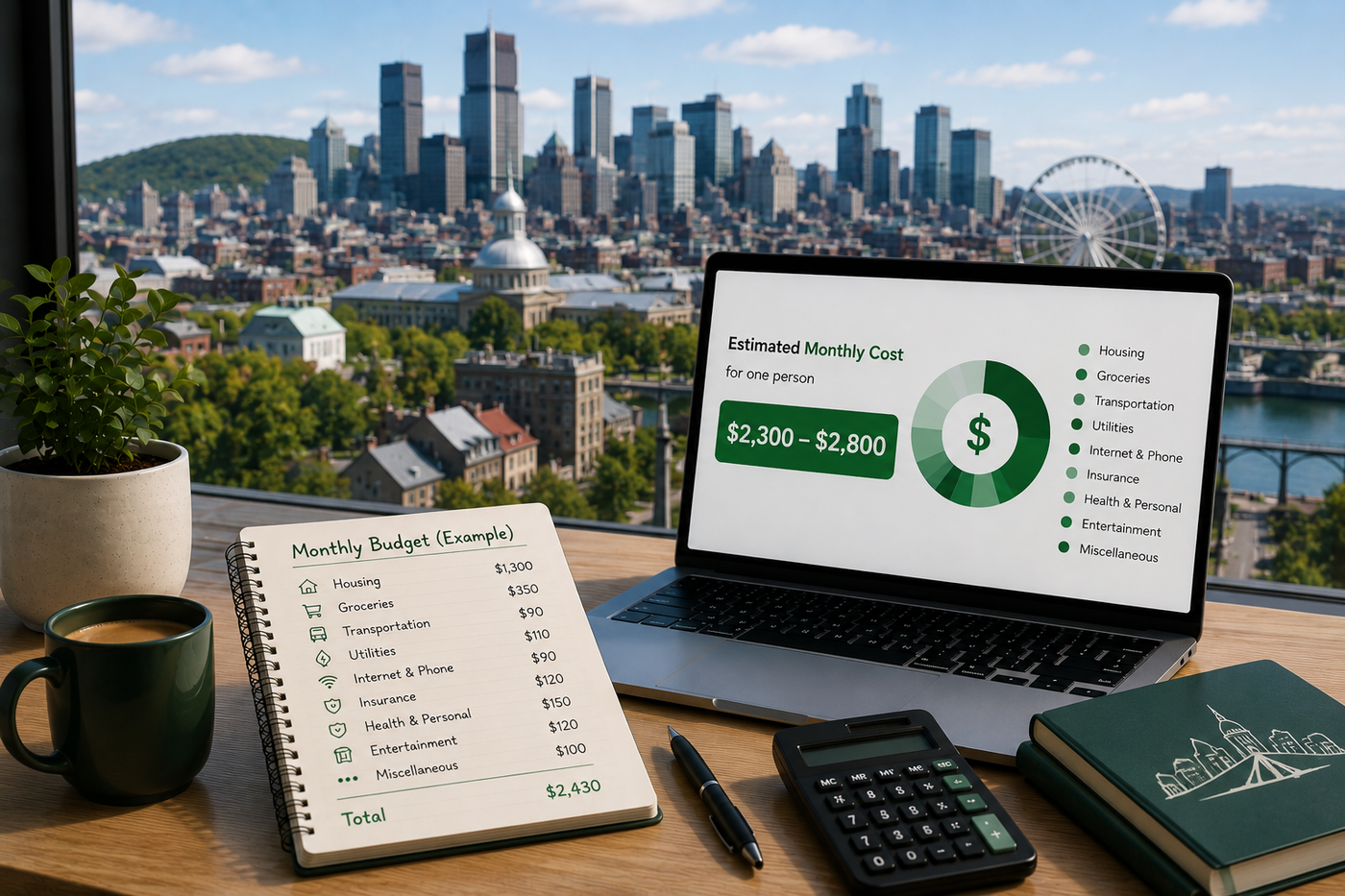
MONTREAL COST OF LIVING
Budget around rent first, then transportation and insurance.
- A solo Montreal renter with roommates often lands around $2,400 to $4,000 per month.
- A solo one-bedroom lifestyle often lands around $3,000 to $5,000 per month before aggressive saving.
- A couple with two children can run from about $6,600 to $11,300 per month depending on rent, childcare, car use, and lifestyle.
What's on this page
Montreal costs depend on rent, transportation, insurance, and household size. Use the ranges in this guide as a practical starting point, then run your own numbers with after-tax income.
This Montreal budget is built for someone choosing a lease, comparing a job offer, or planning the first year in Canada. It uses monthly ranges because rent, commute, family size, insurance, and lifestyle change the answer faster than a single average can.
Use the City Affordability Calculator with your after-tax pay, not salary headline numbers. If you are arriving soon, pair this with the First Month in Canada Checklist and the Ultimate Newcomer Guide to Canada.
Run your own Montreal number
Replace these ranges with your income, rent, commute, insurance quote, and household size.
Quick Montreal monthly budget ranges
Montreal monthly cost ranges in 2026
These are practical monthly ranges before unusual debt, tuition, major medical costs, large remittances, or aggressive investing.
| Household | Lean lifestyle | Middle lifestyle | Higher lifestyle |
|---|---|---|---|
| Solo, shared housing | $2,400 to $3,200 | $3,200 to $4,000 | $4,000 to $5,300 |
| Solo, one-bedroom | $3,000 to $3,900 | $3,900 to $5,000 | $5,000 to $6,600 |
| Couple, no kids | $4,200 to $5,500 | $5,500 to $7,100 | $7,100 to $9,400 |
| Couple with 1 child | $5,500 to $7,200 | $7,200 to $9,400 | $9,400 to $12,500 |
| Couple with 2 children | $6,600 to $8,600 | $8,600 to $11,300 | $11,300 to $15,000 |
Rent is the first number to solve
Montreal rent can be $750 to $1,200 for a room or shared place, $1,000 to $1,600 for a studio, $1,300 to $2,100 for a one-bedroom, $1,700 to $2,900 for a two-bedroom, and $2,200 to $3,700 for a three-bedroom or family-sized place. These are planning ranges, not promises. A renovated unit, pet-friendly lease, parking spot, short commute, elevator building, or school catchment can move the rent up fast.
Plateau, Mile End, Griffintown, Old Montreal, Downtown, Little Burgundy, and newer REM-adjacent buildings cost more. Hochelaga, Rosemont, Villeray, Ahuntsic, Verdun, Saint-Henri, Lasalle, Longueuil, Laval, and older walk-ups can lower rent, but language, commute, and lease timing matter.
Before you send money, ask what is included: heat, water, electricity, internet, parking, storage, laundry, air conditioning, tenant insurance requirements, move-in fees, and whether you can install your own internet provider. A cheaper apartment can become more expensive if it needs a car, extra utilities, paid laundry, and long rides home.
Utilities, heat, water, and electricity
Montreal utilities can be $50 to $150 per month for a small apartment when heat is included, $90 to $250 for an electrically heated apartment, and $180 to $400 for a larger home or poorly insulated unit in winter.
Ask the landlord for a real utility history or a previous bill. A small apartment with heat included can feel cheap. An older house, electric heat, drafty windows, air conditioning, in-suite laundry, or several people working from home can turn utilities into a much larger line.
Internet and phone
For a simple starting budget, use $50 per month for home internet with Oxio and $30 per month for a basic Public Mobile plan. A solo renter should budget about $80 to $130 for internet plus phone. A couple should budget $110 to $190. A family should budget $140 to $280 depending on phones, data, devices, and whether kids need lines.
Newcomers often overpay here because they walk into the first mall kiosk after landing. Set up the basics first, read the conditions, and use welcome bonuses where the service fits your life.
 Public MobileGet a $10 referral credit when activating an eligible Public Mobile plan. Public Mobile is a Canadian prepaid mobile provider with self-serve plans.Referral
 OxioGet one free month of internet service, worth about $50 depending on the plan. Oxio is an internet provider offering simple home internet plans in many Canadian markets.Referral
Transit and commuting
STM and ARTM transit can be about $100 to $125 per adult per month depending on zone and pass type. A couple should budget $200 to $360, and a family can land around $250 to $600 when older children, occasional taxis, REM trips, or off-island travel are added.
A transit-first budget works best when home, work, school, groceries, childcare, and social life sit on the same route network. If the cheaper rental saves $400 but adds rideshares, parking, or a second car, the rent saving can disappear.
Car ownership and insurance
A car in Montreal can add $450 to $1,200 per month once insurance, registration, gas, winter tires, snow clearing, maintenance, parking, payments, and tickets are counted. Quebec insurance often feels cheaper than Ontario, but street parking, winter rules, potholes, and bridge traffic can still make the car line heavy.
Run the car line before you choose the apartment. Add insurance, gas, maintenance, parking at home, parking at work, winter tires, registration, repairs, interest, and depreciation. If the car helps you access cheaper rent, write both numbers together instead of treating rent and transportation separately.
Groceries and household basics
A solo Montreal grocery budget can be $300 to $580 per month if you cook and shop at Super C, Maxi, Walmart, Costco, Adonis, PA, Segal's, Jean-Talon Market, Atwater Market, fruiteries, or neighbourhood bakeries. A couple usually lands around $600 to $1,150. Families can spend $900 to $1,900 before restaurants, school snacks, diapers, and specialty foods.
Household basics add up during the first year: cleaning products, laundry, toilet paper, medicine, kitchen tools, lunch containers, coffee, school snacks, pet food, and replacements for things you left behind. A realistic monthly food-and-household line beats a perfect grocery receipt from one cheap week.
 GoCouponsAccess grocery coupons with a listed total value of about $70. GoCoupons publishes Canadian grocery coupons that are renewed monthly.Referral
 InstacartGet $10 off through the referral link. Instacart is a grocery delivery and pickup platform connected to many Canadian grocery stores and retailers.Referral
Restaurants, delivery, coffee, and fun
Montreal gives you many low-cost choices: BIXI, parks, free festivals, Mount Royal, neighbourhood cafes, libraries, and markets can keep fun near $120 to $300 per adult. Canadiens tickets, terraces, bars, concerts, ski weekends, restaurants, delivery, museums, and late rides home can push one adult toward $400 to $1,100 per month.
Delivery is a convenience line, not a grocery line. If you are setting up a new place, welcome offers can make the first few orders useful while you buy cookware and stock the pantry. After that, build a monthly delivery cap so it does not silently eat the savings line.
 Too Good To GoFind cheap food for good value from local merchants when bags are available. Too Good To Go helps restaurants, bakeries, cafes, and grocery partners sell surplus food in discounted surprise bags.Referral
 DoorDashGet $5 off each of your first three eligible orders. DoorDash is a food and convenience delivery platform available in many Canadian cities.Referral
 Uber Eats$20 off your first two eligible orders, for a total potential value of $40. Uber Eats is a food delivery app for restaurants, convenience stores, groceries, and local merchants.Referral
Tenant insurance, home insurance, and personal protection
Tenant insurance can be about $20 to $50 per month for many renters, depending on coverage, deductible, building, claims history, and belongings. Condo or house insurance can be much higher. Add more if you need life insurance, extra health or dental coverage, travel insurance, or pet insurance.
Do not skip insurance because the monthly number looks small. A laptop, bike, liability claim, water damage issue, or temporary accommodation need can cost more than years of premiums.
Childcare, school, and kids
Children change the budget more than almost any category after rent. Childcare can range from a few hundred dollars to more than $1,500 per child per month depending on age, subsidy, provider, schedule, province, and whether you get a spot. School-age care, camps, sports, lessons, clothing, birthdays, dental, and activities can add $250 to $900 per child per month even after daycare years.
Public school can keep tuition at $0, but families still pay for lunches, supplies, field trips, after-school care, shoes, winter gear, summer camps, tutoring, sports, and transportation. A second child does not double every expense, but it can double childcare and activities.
Health, fitness, pets, clothes, and personal care
A solo adult can keep personal extras around $100 to $300 per month with basic haircuts, community centres, low shopping, and limited subscriptions. A more normal range is $250 to $700 with gym, haircuts, skincare, clothes, prescriptions, dental copays, hobbies, and occasional gear. A couple can spend $400 to $1,200. Families can spend $700 to $2,000 once kids' clothes, sports, dental, prescriptions, activities, and replacements are counted.
Pets can add $80 to $300 per month for food, litter, insurance, vet savings, grooming, dog walking, and pet rent pressure. Pet-friendly rentals can also cost more or take longer to find.
Savings, debt, and breathing room
A city budget without savings breaks quickly. A solo renter should aim for at least $250 to $900 per month in savings once the basics are covered. A couple should aim for $500 to $1,800. A family should aim for $700 to $2,800 because one dental bill, childcare gap, car repair, move, or job delay can wipe out a thin account.
If you carry debt, student loans, remittances, immigration costs, or family support, add those lines before choosing rent. Use after-tax pay, not salary headline numbers. A comfortable salary can feel tight after rent, transit, insurance, phone, internet, groceries, debt repayment, and savings.
Budget and income tools
Use these after you choose rent and before you commit to a lease or car.
First-month Montreal setup costs
First month in Montreal can cost much more than a normal month because you may need rent, deposit or last month rent, movers, furniture, kitchen basics, phone, internet, tenant insurance, transit passes, groceries, and emergency cash before your routine settles.
First-month Montreal setup budget by household
These ranges use the same categories discussed above, plus upfront move-in costs. The total row is bolded so you can copy it into your own budget.
| Expense category | Solo | Couple | 1 kid | 2 kids |
|---|---|---|---|---|
| First month rent | $750 to $2,100 | $1,700 to $2,900 | $2,200 to $3,400 | $2,500 to $3,700 |
| Lease and startup cash | $0 to $500 | $0 to $700 | $0 to $900 | $0 to $1,100 |
| Furniture and kitchen basics | $500 to $2,300 | $800 to $3,200 | $1,100 to $4,200 | $1,400 to $5,000 |
| Moving costs | $100 to $900 | $200 to $1,300 | $300 to $1,700 | $400 to $2,000 |
| Phone and internet setup | $80 to $250 | $110 to $300 | $110 to $350 | $140 to $400 |
| Insurance setup | $20 to $220 | $30 to $320 | $40 to $450 | $50 to $600 |
| Transit, rideshare, or car start | $100 to $1,000 | $200 to $1,600 | $250 to $2,000 | $300 to $2,500 |
| Groceries and household stock-up | $600 to $1,350 | $1,000 to $2,000 | $1,250 to $2,600 | $1,600 to $3,200 |
| Emergency buffer | $1,000 to $2,800 | $1,400 to $3,800 | $1,800 to $4,800 | $2,200 to $5,800 |
| Total first-month cash | $3,150 to $11,420 | $5,440 to $16,120 | $7,050 to $20,400 | $8,590 to $24,300 |
For discounts attached to real setup tasks, use the welcome bonus guide. For banking, start with Best Bank Accounts for Newcomers to Canada.
Summary: Montreal monthly ranges by household
How much money you need to live in Montreal in 2026
These totals match the category ranges above. Add debt, tuition, immigration fees, unusual medical costs, or aggressive investing on top.
| Household | Lean lifestyle | Middle lifestyle | Higher lifestyle |
|---|---|---|---|
| Solo, shared housing | $2,400 to $3,200 | $3,200 to $4,000 | $4,000 to $5,300 |
| Solo, one-bedroom | $3,000 to $3,900 | $3,900 to $5,000 | $5,000 to $6,600 |
| Couple, no kids | $4,200 to $5,500 | $5,500 to $7,100 | $7,100 to $9,400 |
| Couple with 1 child | $5,500 to $7,200 | $7,200 to $9,400 | $9,400 to $12,500 |
| Couple with 2 children | $6,600 to $8,600 | $8,600 to $11,300 | $11,300 to $15,000 |
For a solo renter in Montreal, the difference between the lean and higher range is usually rent privacy, restaurants, car use, subscriptions, travel, and savings. For a couple, the jump usually comes from the second bedroom, a car, insurance, restaurants, and how much they save. For families, childcare, car ownership, activities, housing size, and neighbourhood drive the budget.
Related articles:
 Read next
Page details
Author: Canooq Editorial
Updated: June 15, 2026
Cite this page: Canooq.ca, How Much Money Do You Need to Live in Montreal in 2026?, https://www.canooq.ca/blog/how-much-money-live-in-montreal-2026
Canooq content is educational and may include affiliate or referral links. It is not financial, tax, legal, immigration, employment, mortgage, real estate, or healthcare advice. Verify official sources and provider terms before acting.