Canadian taxes for newcomers: the complete starting guide
Your Canadian tax path starts with residency, not citizenship. This guide takes you from the first paycheque and T4 slip through filing, CRA My Account, refunds, benefits, and long-term accounts such as the TFSA, RRSP, and FHSA.
Read this before your first Canadian paycheque or tax season.
Start with your situation
Not every rule applies to everyone. Find your closest row, collect those records, then work through the guide. You can fit more than one row.
| Your situation | Collect first | Pay attention to |
|---|---|---|
| Employee | Pay stubs, T4, benefit and pension statements | Employment income, payroll deductions, work expenses only if eligible |
| Self-employed or gig worker | Invoices, platform statements, business receipts, mileage records | Business income, expenses, GST/HST registration questions, CPP obligations |
| International student | T2202, scholarships, job slips, residency facts | Residency status, tuition amounts, employment income, benefits eligibility |
| Family with children | Both partners' income, children's information, childcare receipts | CCB and related provincial benefits, childcare expenses, marital-status updates |
| Investor or property owner abroad | Foreign statements, cost on arrival, income, tax paid, ownership records | Worldwide income, foreign tax credits, treaty rules, possible T1135 reporting |
| Temporary worker or non-resident | Permit dates, travel days, home and family ties, Canadian slips | Residency determination, Canadian-source income, treaty position |
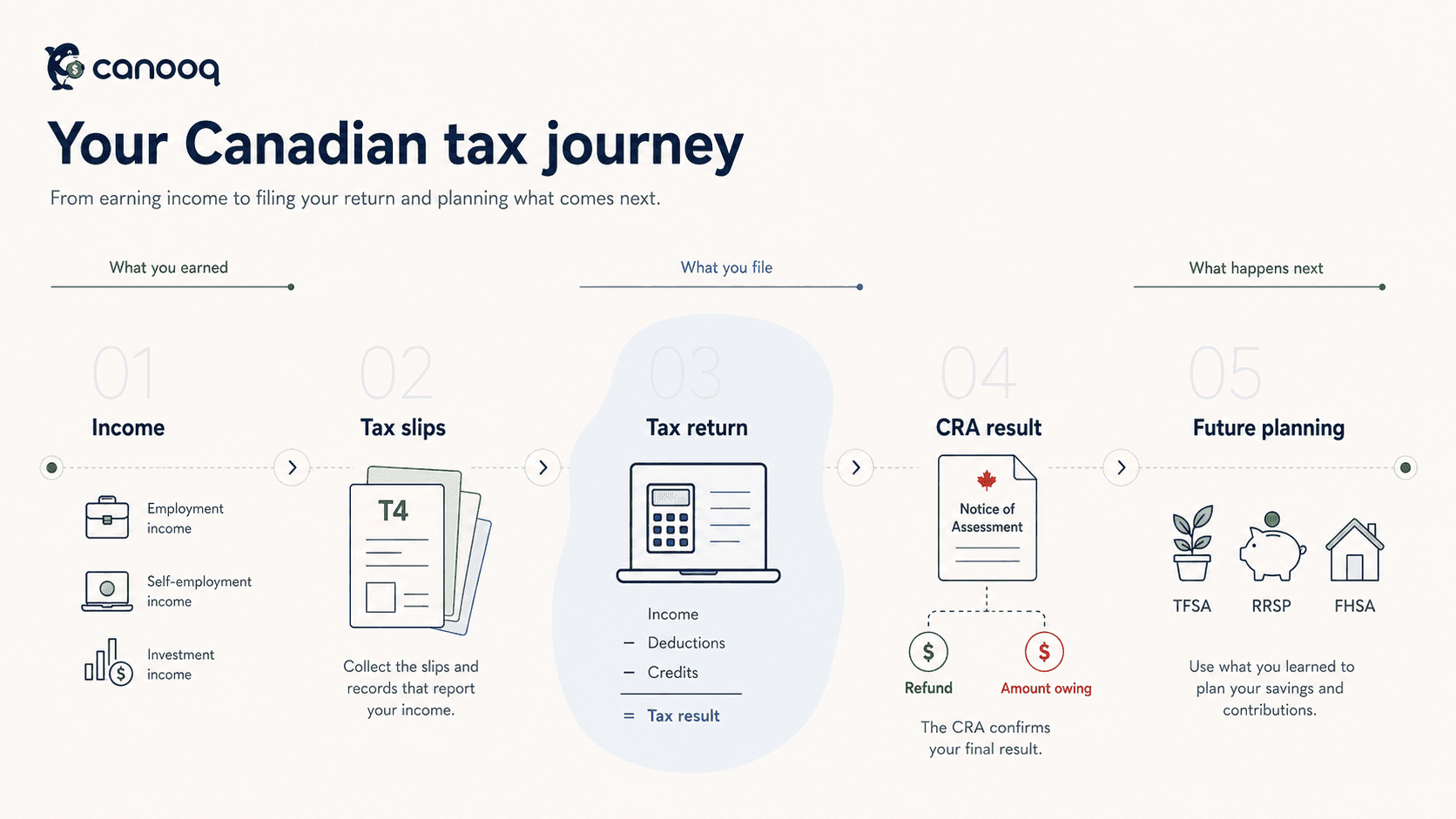
The whole system in one picture
Money comes in, payers issue slips, you report income and claims on a return, and CRA assesses the result. Registered accounts belong at the end of the sequence because eligibility and contribution room depend on facts established earlier.
Do I pay tax in Canada, my home country, or both?
1 · Decide Canadian residency
CRA looks at residential ties and your facts. A home, spouse or partner, dependants, length and purpose of stay, and treaty ties can matter. Your permit label does not settle the tax answer.
2 · Split the arrival year
A resident generally reports worldwide income for the resident part of the year. CRA may also ask for pre-arrival world income to calculate credits and benefits, even though that amount is not automatically taxed as resident-period income.
3 · Apply treaty and credits
Your home country may still require a return. A treaty can assign residence or taxing rights, and a foreign tax credit can recognize eligible tax already paid. These rules reduce double taxation; they do not mean you can omit the income.
Get cross-border help early
Use a Canadian professional with experience in your other country if you own foreign property, a company, trust, pension, substantial investments, or assets that may trigger foreign reporting. Save the fair market value and cost records from your arrival date.
Your paycheque: gross pay becomes net pay
An employer starts with gross pay and subtracts required or authorized amounts. Income tax is a prepayment toward the annual calculation. CPP or QPP builds pension entitlement, while EI funds employment-insurance programs. Neither CPP nor EI is the same thing as income tax.
Start
Gross pay
Prepaid tax
Income tax
Pension contribution
CPP or QPP
Insurance premium
EI
Bank deposit
Net pay
Compare every pay stub with your job offer: hourly rate or salary, hours, vacation pay, benefits, pension, union dues, and year-to-date totals. Use Canooq's salary after tax calculator for planning, then use the pay stub as the source of truth.
How progressive tax brackets work
Canada uses tax brackets. Reaching a higher bracket does not apply the higher rate to every dollar you earned. Each slice of taxable income keeps the rate assigned to that slice. Federal and provincial or territorial calculations both contribute to the final result.
One income, taxed in slices
Your marginal rate applies to the next dollar in your current bracket. Your average rate is total income tax divided by income. A deduction can reduce taxable income; a credit reduces tax under its own rules. A refund only tells you how the final tax compares with amounts already paid.
Tax slips: what a T4 means
A slip is a report from an employer, bank, school, government, or other payer. It does not file your return. Your return brings all slips, other income, deductions, and credits together.
| Slip | What it reports | Who sends it | What to notice |
|---|---|---|---|
| T4 | Employment income | Employer | Box 14 income; boxes 16/16A CPP, 18 EI, 22 income tax |
| T4A | Pensions, scholarships, fees, commissions, or other payments | Payer | Read the box code because different payments receive different treatment |
| T5 | Interest and some investment income | Bank or investment firm | Common when taxable accounts pay interest or distributions |
| T3 | Trust and mutual-fund income | Trust or investment firm | May arrive later than a T4 |
| T2202 | Eligible tuition information | College or university | Supports tuition-related reporting; it is not employment income |
| T5007 | Workers' compensation or social assistance | Government or payer | Often affects calculations even when the amount itself receives special treatment |
| Relevé slips | Quebec provincial reporting | Employer, institution, or payer | Used for the Revenu Québec return; a Quebec employee often receives a T4 and Relevé 1 |
Read a T4 in four boxes
Box 14 is employment income. Box 22 is income tax deducted. Boxes 16 and 16A show CPP contributions outside Quebec, while Quebec uses QPP boxes. Box 18 shows EI premiums. Other boxes cover pensionable earnings, insurable earnings, benefits, and special codes.
Match it to your records
Compare the T4 against the year-to-date totals on your final pay stub. Ask the employer about differences, a wrong SIN, name, province, or missing income. Save corrected slips with the original.
How to file your first return
- 01
Confirm the residency date
Write down when you established Canadian residential ties. Collect travel dates and facts that support the answer.
- 02
Collect identity and family details
Use your SIN or CRA-issued tax number, current address, immigration date, marital status, spouse or partner information, and dependant details.
- 03
Collect Canadian and foreign income
Gather slips plus self-employment, rental, investment, pension, scholarship, and foreign-income records for the relevant period.
- 04
Collect possible claims
Keep childcare, moving, medical, donation, tuition, business, home-office, union, professional, and registered-account receipts when they apply.
- 05
Choose a filing route
Use NETFILE-certified software, a tax preparer, a free community tax clinic if eligible, or a paper return. Quebec residents also file with Revenu Québec.
- 06
Review before submitting
Check name, SIN, address, residency date, marital status, direct deposit, every slip, foreign income, and unused tuition or registered-account information.
- 07
Save the result
Keep the filed return, confirmation number, receipts, and Notice of Assessment. The assessment becomes the reference for CRA access and next year's room.
How to create and use your CRA account
- 1
Start at canada.ca
Use the official CRA account registration page, never a link from an unexpected email or text.
- 2
Choose a sign-in method
CRA may offer a CRA credential, Sign-In Partner, or provincial partner. Use the option shown on the current official page.
- 3
Verify your identity
Have your SIN, date of birth, an assessed return, and the requested line amounts ready. Available document-verification options can change.
- 4
Set multi-factor authentication
Use a phone or passcode-grid method you can keep through a move or phone-number change. Store recovery information securely.
- 5
Turn on notifications and direct deposit
Email notifications tell you when CRA posts mail. Direct deposit sends refunds and eligible payments to the bank account you control.
After filing: assessment, refund, balance, and benefits
Notice of Assessment
Compare CRA's assessed amounts with the return you submitted. Read every explanation and date. If CRA changed a line or asks for proof, respond through the official channel and keep copies.
Refund or amount owing
A refund usually means too much tax was prepaid or refundable credits applied. A balance means the annual calculation exceeded payments and credits. If you cannot pay in full, file on time and contact CRA about payment options.
Benefits and credits
CRA uses family income, marital status, children, and residency information for programs such as the GST/HST credit and Canada Child Benefit. Newcomers may apply for some payments before the first tax return, then both partners must keep filing to maintain income-tested payments.
Changes and objections
A missed slip or receipt does not require filing a second return. Wait for assessment, then use Change my return, ReFILE, or the paper adjustment process. Formal objection deadlines apply when you disagree with an assessment.
TFSA, RRSP, and FHSA: learn them in that order
Registered is a tax label, not an investment. A TFSA, RRSP, FHSA, or RESP can hold cash, GICs, mutual funds, ETFs, or other qualified investments depending on the provider. Choose the account for the goal and tax treatment, then choose what it holds.
| Account | Main use | Contribution deduction | Withdrawal treatment | Newcomer starting point |
|---|---|---|---|---|
| TFSA | Flexible saving and investing | No | Qualifying withdrawals are tax-free; withdrawn room generally returns next calendar year | Room starts in the year you become a resident and meet age/SIN rules |
| RRSP | Retirement and some home or education programs | Usually | Withdrawals are generally taxable | Room is based mainly on prior earned income and appears after CRA assesses a return |
| FHSA | First qualifying home | Generally | Qualifying home withdrawal is tax-free | Must meet age, residency, and first-time-buyer rules; room starts after opening |
| RESP | A child's post-secondary education | No | Growth and grants are generally taxed to the student when paid for school | The beneficiary needs a SIN; grants have eligibility rules |
| Non-registered account | Saving or investing after registered-room decisions | No | Interest, dividends, and capital gains may be taxable | No contribution-room limit, but tax records matter |
Tax-free
TFSA growth and qualifying FHSA home withdrawals are generally tax-free. The contribution itself is not deductible for a TFSA.
Tax-deferred
An RRSP deduction can reduce taxable income now. Growth stays sheltered inside, and withdrawals are generally included in taxable income later.
Room is a hard ceiling
Check official room and your own transactions before contributing. CRA account figures can lag recent deposits or withdrawals, and overcontributions can create monthly tax.
A first-year tax calendar
ARRIVAL
Record residency facts
Save entry date, housing, family ties, foreign asset values, and pre-arrival income.
EVERY PAY
Check the pay stub
Compare rate, hours, tax, CPP or QPP, EI, benefits, and year-to-date totals.
FEBRUARY TO APRIL
Collect, file, save
Gather slips and receipts, prepare the return, and keep submission proof.
AFTER ASSESSMENT
Read CRA's result
Verify assessment, benefits, direct deposit, and registered-account room.
20 common newcomer tax questions
Do newcomers have to file a Canadian tax return?
CRA says newcomers file for the year they become residents for tax purposes. Filing also lets CRA calculate refunds, credits, and benefits. Your spouse or common-law partner may need to file even with little or no income.
Is tax residency the same as immigration status?
No. Tax residency depends mainly on residential ties and facts such as where you live, while immigration status determines whether you may enter, live, study, or work in Canada.
Do I report income from my home country?
A Canadian tax resident generally reports worldwide income earned during the part of the year they were resident. Pre-arrival income can also be requested to calculate benefit eligibility. Convert foreign amounts to Canadian dollars using an accepted exchange rate.
Will I pay tax twice on the same income?
Canada's tax treaties and foreign tax credits can reduce double taxation, but the result depends on the countries, income type, residency dates, and tax already paid. Cross-border cases deserve professional advice.
What is a T4 slip?
Your employer issues a T4 for the calendar year. It reports employment income and payroll amounts such as income tax, CPP or QPP, and EI. You use its numbered boxes when preparing your return.
What if I have more than one T4?
Report every slip. Multiple jobs can lead to too little tax being withheld because each employer calculates deductions separately, so your final return may show tax owing.
What if my T4 is missing or wrong?
Ask the employer for the slip or correction. Check CRA My Account for slips already received by CRA. Do not omit income because a paper slip did not arrive.
Why is my net pay lower than my salary?
Employers subtract income tax, CPP or QPP contributions, EI premiums, workplace benefits, pension contributions, union dues, or other authorized deductions from gross pay.
What is a tax refund?
A refund means your return calculated that too much tax was paid during the year or refundable credits apply. It is a reconciliation, not a separate bonus.
What is a Notice of Assessment?
The Notice of Assessment is CRA's summary after processing your return. It confirms or changes the calculation and usually shows your refund or balance, RRSP deduction limit, and other account information.
Can I create a CRA account before filing my first return?
Registration methods can change. CRA's standard identity questions use information from an assessed return. Start at the official registration page and follow the route offered to you; after your first return is assessed, keep that return available for verification questions.
Does CRA My Account file my tax return?
No. You file through certified tax software, a tax preparer, a free tax clinic if eligible, or a paper return. My Account lets you view slips, assessments, benefits, contribution information, and return status.
When is the personal tax deadline?
Most individuals file and pay any balance by April 30 following the tax year. A self-employed person and their spouse or common-law partner usually have a later filing deadline, but any balance is still generally due April 30. Confirm the current year's dates with CRA.
Do Quebec residents file twice?
Quebec residents file a federal return with CRA and a provincial return with Revenu Québec. They may receive both T4 and Relevé 1 employment slips.
What is a TFSA?
A TFSA is a registered account where eligible contributions are not deductible, but investment growth and qualifying withdrawals are generally tax-free. New residents start gaining room in the year they become Canadian tax residents.
What is an RRSP?
An RRSP is a retirement account. Eligible contributions can create a tax deduction, investments grow tax-deferred, and withdrawals are generally taxable. Newcomers often need Canadian earned income and an assessed return before meaningful room appears.
What is an FHSA?
An FHSA helps an eligible first-time home buyer save. Contributions are generally deductible and qualifying home withdrawals are tax-free. Room starts only after opening the first account, subject to eligibility and limits.
Should I open every registered account immediately?
No. First confirm residency, eligibility, contribution room, near-term cash needs, employer matching, and goals. Opening an account does not mean you must invest at once, but overcontributions can trigger tax.
Do international students file taxes in Canada?
Their tax residency determines the answer. Many students establish enough residential ties to file as residents, while others remain non-residents. Tuition slips and income do not decide residency by themselves.
When should I hire a cross-border tax professional?
Get specialist help when you own a foreign company, trust, rental property, substantial investments or foreign assets, receive stock compensation or pensions, keep strong ties to another country, or face conflicting residency claims.
Official tax sources
Tax information, not personal tax advice
Residency, treaties, foreign property, businesses, trusts, stock compensation, pensions, and family situations can change the answer. Use current CRA and Revenu Québec sources and hire a qualified cross-border professional when your facts span countries.
Enjoy Canooq? Let us keep helping you — make Canooq a preferred source on Google.