What is CADD, and what can a Canadian-dollar stablecoin do?
CADD is a stablecoin: a digital token meant to stay at one Canadian dollar. Tetra Trust backs each one with a dollar held in trust, and it isn't a bank deposit.

AT A GLANCE
CADD in short
- A digital token built to stay at one Canadian dollar, issued by Tetra Trust.
- It pays no interest and has no deposit insurance.
- Redeeming directly with Tetra costs at least $50, plus tax.
CADD is a digital token that's built to always be worth one Canadian dollar. A company called Tetra Trust issues it. For every CADD it creates, it sets aside one real dollar, so the token can be traded back for that dollar later.
A token like this is called a stablecoin: a kind of cryptocurrency whose price is meant to stay put, unlike Bitcoin's. You can send it to someone else over the internet at any hour, without going through a bank. The best-known stablecoins are tied to the US dollar. CADD gives Canadians one in their own currency.
It comes from a private company, not from the government or the Bank of Canada.
How does it stay at one dollar?
When someone buys a new CADD from Tetra, they pay $1. Tetra puts that dollar in a trust, where it's held in cash and short-term government debt. When a holder hands the CADD back, the token is destroyed and the dollar is paid out. One token, one dollar, in both directions.
So CADD isn't an investment. Its price isn't supposed to rise, and it pays you no interest.
Two words come up whenever you use it. A blockchain is the shared online record that shows who holds which tokens. A wallet is the app or service you use to hold yours and send them. Some platforms run the wallet for you. With your own wallet, you alone hold the password that moves the tokens, so keep it safe.
What would you use it for?
Mostly, CADD helps people who already use crypto services.
If you're Canadian and you hold a US-dollar stablecoin, its value in Canadian dollars moves every time the exchange rate does. Hold CADD and a dollar stays a dollar.
A business can use it to pay another business at midnight or on a Sunday, when bank transfers don't move. Turning the tokens back into dollars in a bank account is a separate step, and that one still runs on bank time.
It could also be another way to send money abroad. The person on the other end still has to convert it into euros or pesos, so compare the exchange rate and the fees for buying, sending and cashing out with what a regular transfer service charges.
You can pay a shop with it only if the shop accepts CADD.
| If you want to | CADD |
|---|---|
| Hold Canadian dollars on a crypto platform | Does this |
| Stop holding US-dollar tokens | Does this, where the platform supports CADD |
| Earn interest on savings | Pays none |
| Pay a business | Works only if the business accepts it |
| Get dollars back in your bank | Sell it on a platform, or redeem it with Tetra |
How do you turn it back into dollars?
Most people buy and sell CADD on a crypto platform that lists it. When you sell there, you get the price that platform offers, minus its fees, so you may end up with slightly less than $1 per token.
The other way is to redeem with Tetra directly, which mostly suits businesses moving large amounts. The fee is $50 or 0.25% of the amount, whichever is more, plus tax.
Imagine Leo redeems $10,000 of CADD:
- Leo hands back 10,000 CADD, worth $10,000.
- 0.25% of $10,000 is $25. That's less than the $50 minimum, so the minimum applies.
- Leo pays $50, plus tax.
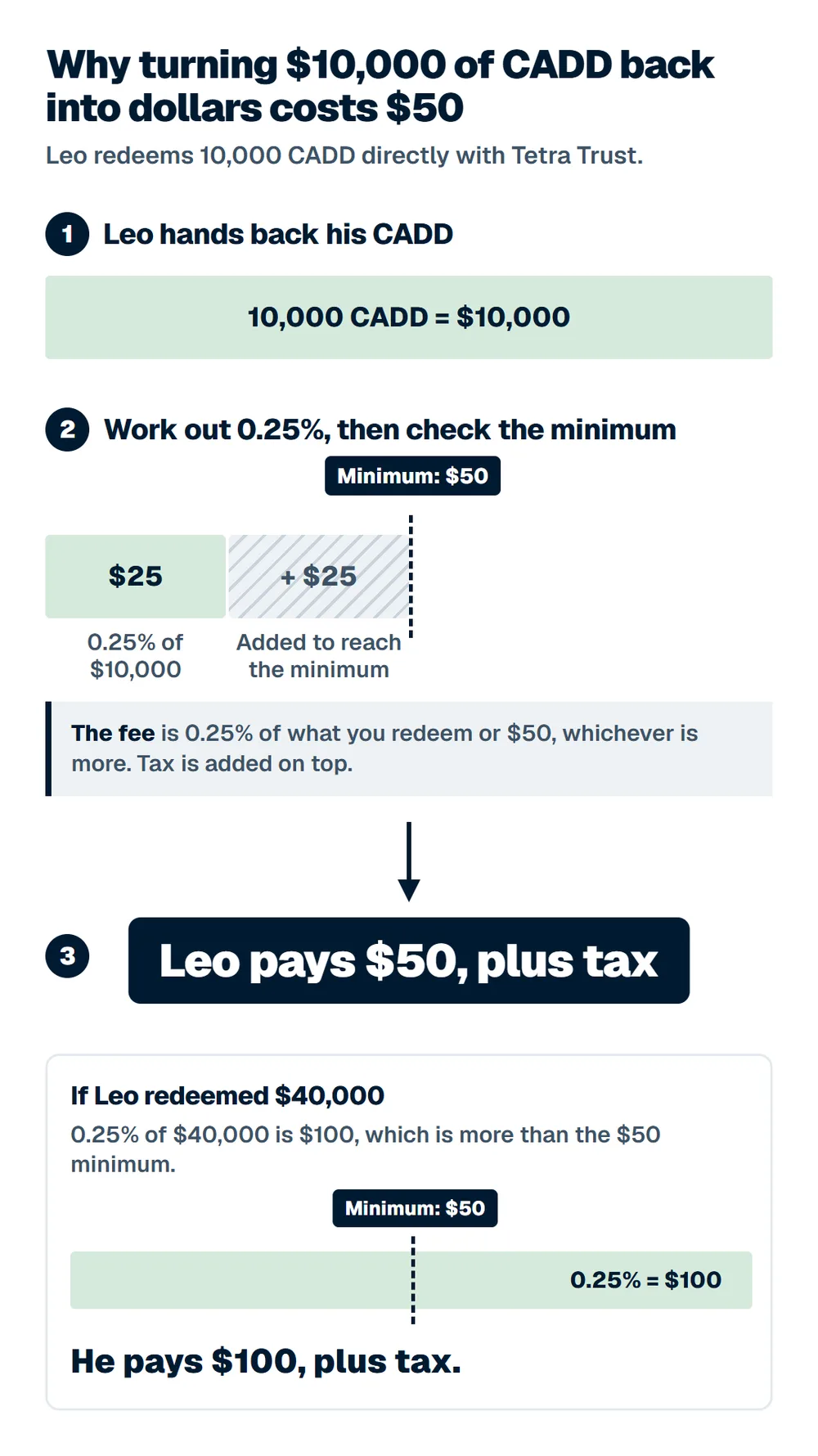
The 0.25% only becomes the bigger number once you redeem more than $20,000. On $40,000, the fee is $100.
When you send CADD anywhere, choose the right network. It runs on several, including Ethereum, Solana and Base, and the receiving wallet has to be on the same one. Tetra publishes the official contract address for each network. Check it, because anyone can create a fake token and name it CADD.
Is your money protected?
Less than in a bank account. CADD isn't a bank deposit, so the Canada Deposit Insurance Corporation, which protects savings when a bank fails, doesn't cover it.
What you have is this. Tetra Trust is a trust company regulated in Alberta. It says every CADD is backed by one dollar, and it publishes a reserve report every day. Those daily reports come from CAD Digital and nobody outside checks them. Once a month, the accounting firm Baker Tilly confirms the reserves as they stood on one particular date.
What about Canada's new stablecoin rules?
Canada passed a Stablecoin Act in March 2026. The detailed rules were published as a draft on October 24, and they're expected to start in fall 2027. They cover how stablecoin companies hold their reserves, how you get your money back and how they keep things running. The Bank of Canada will register and supervise the companies.
None of that is in force yet, so for now CADD's protection is what Tetra itself provides. Our 2026 federal budget coverage explains where the new rules came from.
If a service you already use adds CADD, check what it costs to get your dollars in and back out before you move any money.
Page details
- Written by
- Thomas Tremblay
- Last updated
- November 13, 2026
Sources
Sources checked for this article
Prices and offers were checked on November 13, 2026. The article identifies any conflicting or unannounced terms.
- tetradg.com: CADD | Canadian-Dollar StablecoinproviderChecked 2026-11-13
- bankofcanada.ca: StablecoinsfederalChecked 2026-11-13
- canada.ca: Canada’s Stablecoin Framework - Canada.cafederalChecked 2026-11-13
- tetradg.com: Tetra Trust Indenture | TetraproviderChecked 2026-11-13
- gazette.gc.ca: Canada Gazette, Part 1, Volume 160, Number 43: Stablecoin RegulationsfederalChecked 2026-11-13
- tetradg.com: CADD Terms and Conditions | TetraproviderChecked 2026-11-13
- tetradg.com: CADD Reserve Attestations | TetraproviderChecked 2026-11-13
Cite this page: Canooq.ca, What is CADD, and what can a Canadian-dollar stablecoin do?, https://www.canooq.ca/blog/cadd-canadian-stablecoin
Canooq content is educational and may include affiliate or referral links. It is not financial, tax, legal, immigration, employment, mortgage, real estate, or healthcare advice. Verify official sources and provider terms before acting.