Don't Know Anything About Canadian Finances? Start Here

June 5, 2026
A very simple beginner guide to Canadian finances, explaining banking, budgeting, saving, credit, taxes, benefits, TFSA, RRSP, FHSA, debt, housing, insurance, and bonuses.

START HERE
Canadian money basics, explained simply.
If Canadian banking, credit, taxes, TFSAs, RRSPs, mortgages, and benefits all sound like alphabet soup, start here.
- Money is easier when you split it into jobs: spend, save, borrow, invest, pay tax, and protect yourself.
- Start with banking, an emergency fund, and one clean credit habit before chasing advanced strategies.
- TFSA, RRSP, and FHSA are account containers. They are not investments by themselves.
- Use this page as the simple map, then open the full guide when you want more detail.
Want the deeper version?
This page is the simple version. The full guide has the deeper explanations.
What's on this page
If you know nothing about Canadian finances, start here: banking, budgeting, saving, credit, taxes, benefits, investing, registered accounts, debt, housing, insurance, and bonuses in plain language.
Start here if money in Canada feels confusing
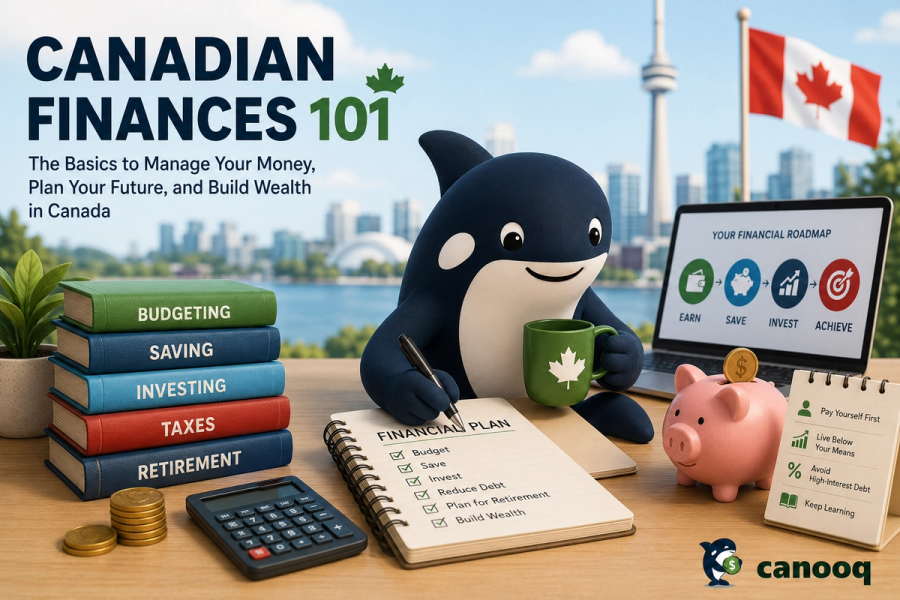
This is the easy version of Canadian Finances 101. Think of Canadian finances like a video game tutorial: you do not need every advanced move on day one. You need the controls, the traps, and the next level.
1. Banking is where your money lives
A chequing account is your everyday money pocket. Paycheques go in, rent goes out, debit purchases happen there, and bills get paid from it. A savings account is where money waits for later, like emergency money, a trip, a tax bill, or a future move.
- New to Canada? Read Best Bank Accounts for Newcomers.
- Compare monthly fees, e-Transfer rules, ATM access, debit card access, and whether the account pays interest.
- A no-fee bank can save you money, but a branch bank can help when you need in-person support.
2. Budgeting means giving every dollar a job
A budget is not punishment. It is a plan. If you earn $3,000 a month after tax, the question is: how much goes to rent, groceries, phone, transit, debt, savings, and fun? If you do not decide, the money still leaves. You just do not know where it went.
- First, cover needs: rent, food, phone, transit, insurance, minimum debt payments.
- Second, save for surprises: dental bills, job gaps, moving costs, repairs, travel emergencies.
- Third, use leftover money for goals: investing, travel, education, buying a home, or bigger purchases.
3. Saving is money for soon
Savings are for money you cannot afford to lose. If you might need the money in the next few months or years, do not treat it like casino money. Keep emergency cash boring, accessible, and separate from spending money.
- Emergency fund: money for bad surprises.
- Short-term savings: money for rent deposits, moving, trips, school, or yearly bills.
- High-interest savings accounts can pay more than basic big-bank savings accounts, but rates change.
4. Credit is your borrowing report card
A credit score is like a school grade for borrowing. Banks, lenders, and sometimes landlords want to know if you pay back money on time. The easiest way to build good credit is boring: use a credit card for normal purchases and pay the full statement balance by the due date.
- Start with How Credit Scores Work in Canada.
- Pay on time. Late payments hurt.
- Keep your balance low compared with your limit.
- Do not apply for a pile of cards at once just because bonuses look tempting.
5. Taxes are how the government settles the bill
Your paycheque may already have tax taken off, but that does not mean you are done. In Canada, most people file a tax return each year. Filing tells the CRA what you earned, what tax you already paid, and whether you get a refund, owe money, or qualify for credits and benefits.
- T4: a tax slip from an employer.
- CRA: Canada Revenue Agency, the tax agency.
- Refund: money back if too much tax was taken or credits apply.
- Balance owing: money you still need to pay.
6. Benefits and credits are money you may qualify for
Benefits are payments or credits from the government. Some help families, workers, students, seniors, people with disabilities, or low/modest-income households. You often need to file taxes to unlock them, even if your income was low.
- Use Canooq's Complete Canadian Benefits Guide for the longer version.
- GST/HST credit: a tax-free payment for eligible people with low or modest income.
- Canada Child Benefit: money for eligible families with children.
- Canada Workers Benefit: support for eligible workers with lower income.
7. Investing is money for later
Investing means buying things that can grow over time, like ETFs, stocks, bonds, GICs, or funds. Investments can go up and down. That is why investing is usually for longer-term goals, not rent money or emergency cash.
- Cash is stable but usually grows slowly.
- GICs are locked or semi-locked savings products with a known rate.
- ETFs can hold many investments at once, which can reduce the risk of betting on one company.
- Stocks are pieces of companies and can move a lot.
8. TFSA, RRSP, and FHSA are containers
This part confuses almost everyone at first. A TFSA is not one specific investment. An RRSP is not one specific investment. An FHSA is not one specific investment. They are containers with tax rules. You can put different eligible investments inside them.
- TFSA: good for flexible saving and investing. Read TFSA Explained.
- RRSP: often used for retirement and tax deferral. Read RRSP Explained.
- FHSA: for eligible first-home savings, with contribution limits and withdrawal rules.
- Not sure which comes first? Read TFSA vs RRSP vs FHSA.
9. Debt is borrowing from future you
Debt is not automatically evil. A mortgage, student loan, or business loan can have a purpose. But high-interest debt, like credit card debt, can grow fast. If a card charges 20% interest, every unpaid purchase becomes more expensive each month.
- Good debt usually has a clear purpose and manageable payments.
- Bad debt usually funds things you cannot afford and charges high interest.
- The fastest guaranteed return is often paying down high-interest debt.
10. Housing is usually the biggest money decision
Rent is a monthly cost. Buying a home adds a mortgage, property tax, insurance, repairs, condo or strata fees, closing costs, and risk. A bank may approve you for a mortgage that still feels too tight in real life.
- Before buying, read Should You Buy a Home in Canada?.
- Renting can be the smart move while income, city, job, or immigration plans are still changing.
- Buying can make sense when your income, down payment, emergency fund, and timeline line up.
11. Insurance protects you from big losses
Insurance is paying a smaller known cost to protect against a bigger unknown cost. Tenant insurance, car insurance, travel insurance, health benefits, disability insurance, and life insurance all solve different problems.
- Tenant insurance protects belongings and liability as a renter.
- Car insurance is required if you own or drive a car.
- Travel insurance matters when provincial health coverage or employer benefits do not cover the full risk.
12. Welcome bonuses are real money, but read the rules
Banks, apps, phone providers, and investing platforms may pay bonuses because they want new customers. This can be free money if you were going to open the account anyway and can meet the conditions without changing your life around the offer.
- Use the Welcome Bonus guide before chasing promos.
- Check the deadline, minimum deposit, direct deposit, bill payment, card spending, or referral rules.
- A $25 easy bonus can be better than a $400 bonus with annoying conditions and monthly fees.
The order I would follow
- Open a reliable chequing account.
- Build a small emergency fund.
- Use one credit card carefully and pay it in full.
- File taxes and learn benefits.
- Move extra cash to better savings rates.
- Learn TFSA, RRSP, and FHSA before investing inside them.
- Only think about home buying after income, debt, cash, and timeline are stable.
That is the simplified map. When you are ready for the deeper version, open Canadian Finances 101.
Related articles:
Page details
Author: Thomas Tremblay
Updated: June 5, 2026
Cite this page: Canooq.ca, Don't Know Anything About Canadian Finances? Start Here, https://www.canooq.ca/blog/canadian-finances-101-short-version
Canooq content is educational and may include affiliate or referral links. It is not financial, tax, legal, immigration, employment, mortgage, real estate, or healthcare advice. Verify official sources and provider terms before acting.
Enjoy Canooq? Let us keep helping you — make Canooq a preferred source on Google.