

If you have celiac disease, the federal budget just made one tax claim a lot easier. Budget 2026, tabled on November 5, proposes letting you put a flat $1,000 for gluten-free food on your medical expenses, with no receipts and no price comparisons. It starts with your 2026 tax return, the one you'll file next spring.
That $1,000 isn't a cheque. It's an amount you add to your medical expense claim, and once your medical costs are high enough to count, it takes about $140 off your federal tax. A parent with two diagnosed kids can claim it for each of them.
What changes for people with celiac disease
You can already claim gluten-free food as a medical expense, but the rules make it a chore. You can only claim the extra cost: say gluten-free bread costs $7 and a comparable regular loaf costs $3.50, then you claim $3.50. The Canada Revenue Agency (CRA) expects a receipt for every gluten-free product, plus a summary of everything you bought over the year, item by item. For someone who eats gluten-free every day, that's hundreds of little subtractions.
The budget replaces all of that with one number. Instead of working out the difference loaf by loaf, you can simply claim $1,000 a year. You don't need to keep grocery receipts or do any maths. Ottawa expects about 35,000 people to use it.
If your real extra cost is higher, and for a family it easily can be, you can still claim the actual amount the old way, with receipts. You just pick one method for that person each year.
How much the $1,000 is worth to you
The $1,000 isn't money the government sends you. It's an amount you add to the list of medical costs you paid during the year. The government then takes 14% of those costs off your federal tax, but only for the part that goes over a minimum. That minimum is 3% of your net income (your income after deductions such as RRSP contributions), and for 2026 it never goes above $2,890.
So your medical costs save you nothing until they pass that minimum. Only the dollars after it count.
Say Maya has celiac disease and her net income is $50,000 a year.
- Her minimum is 3% of $50,000, which is $1,500.
- She adds up her medical costs for 2026: the $1,000 for gluten-free food, $600 at the dentist and $400 in prescriptions. That's $2,000.
- The part over her minimum is $2,000 minus $1,500, so $500.
- She gets 14% of that off her federal tax: $70.
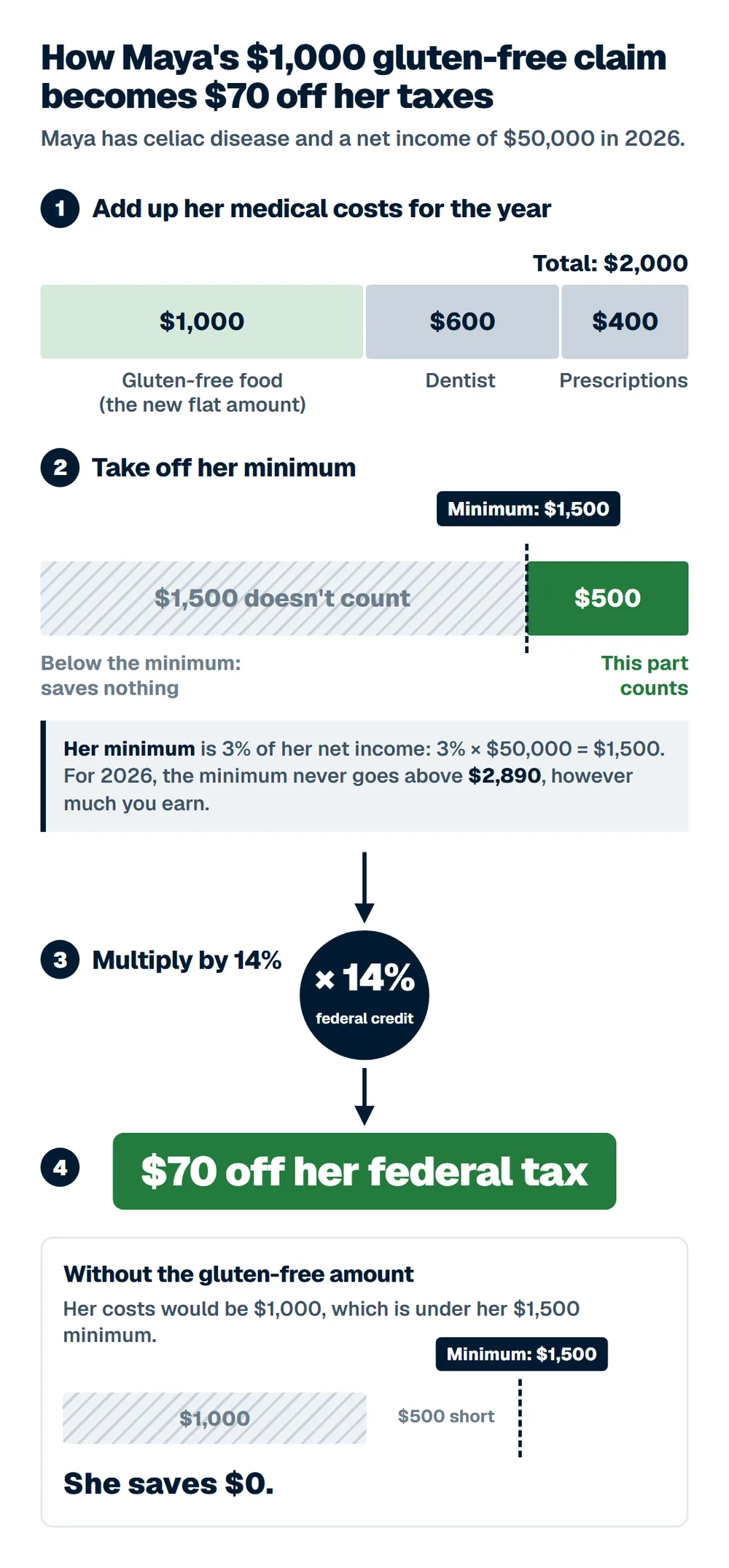
Without the gluten-free amount, Maya's costs would have been $1,000, under her $1,500 minimum, and she'd have saved nothing. The new $1,000 is what got her the $70.
If Maya's other medical costs had already been over her minimum, say from a big dental bill, the whole $1,000 would count and save her $140. And if the gluten-free amount had been her only medical cost, it wouldn't reach the minimum at all, and she'd save nothing.
The lower your income, the lower your minimum. On $20,000 a year, it's only $600, so the $1,000 on its own saves you $56.
These numbers are federal tax only. Your province has its own medical credit, and the budget doesn't say whether provinces will accept the flat $1,000.
Add up the whole family's costs
Maya's dentist and prescriptions made the difference, which is why it pays to put every medical bill in the house on one return. You can group your own expenses with your spouse's or partner's and your children's under 18, as long as you weren't reimbursed for them. Dental work, glasses, prescriptions, physio and the premiums you pay yourself for private health or dental insurance all count. You can also pick any 12-month period that ends in 2026, which helps if a big bill landed in late 2025 and you didn't claim it on last year's return.
It usually works best on the return of whoever has the lower net income, since 3% of a smaller income is a lower minimum. The flat amount goes on the same line as your other medical expenses (line 33099 for you, your partner and your minor kids).
One rule to know: only one person can claim the $1,000 for a given person with celiac disease. If you and your ex both want to claim gluten-free food for the same child, the flat amount isn't available, and each of you would have to claim your actual costs with receipts.
What you need before you claim
You still need a letter from a doctor confirming you have celiac disease and need a gluten-free diet. That's the existing rule, and the budget keeps it. You don't send the letter with your return, but keep it in case the CRA asks.
The measure is still a proposal. Like most tax changes in a budget, it becomes law only once Parliament passes the budget bill. Your 2026 return is due April 30, 2027. Until the bill passes, hang on to your gluten-free grocery receipts. If the flat amount is law by tax time, you won't need them. If it isn't, they're what let you claim the old way.
The $1,000 is one of several new flat amounts in the budget. Starting with 2027, there's also $500 for incontinence products, $2,000 for a service dog and $1,000 for moving costs, among others. What Canada's new budget means for your money goes through them all, and the full budget summary covers the rest of the plan.
Page details
- Written by
- Thomas Tremblay
- Last updated
- November 7, 2026
Sources
Sources and verification
The $1,000 flat amount is proposed in Budget 2026 and needs a budget implementation act. Dollar examples are Canooq calculations at the 14% federal rate and the 2026 threshold.
- Department of Finance Canada: Budget 2026: Tax measures, supplementary informationfederalChecked 2026-11-05
- Canada Revenue Agency: Lines 33099 and 33199: Eligible medical expensesfederalChecked 2026-11-07
- Canada Revenue Agency: Details of medical expenses: gluten-free food productsfederalChecked 2026-11-07
- Canada Revenue Agency: Indexation adjustment for personal income tax and benefit amountsfederalChecked 2026-11-07
- Canada Revenue Agency: Tax rates and income brackets: 2026taxChecked 2026-09-25
Cite this page: Canooq.ca, Do you have celiac disease? You could claim $1,000 for gluten-free food, no receipts, https://www.canooq.ca/blog/celiac-gluten-free-food-1000-tax-claim-budget-2026
Canooq content is educational and may include affiliate or referral links. It is not financial, tax, legal, immigration, employment, mortgage, real estate, or healthcare advice. Verify official sources and provider terms before acting.