

If you live in BC, you pay income tax twice: once to the federal government and once to the province. Both work the same way. Your income is cut into slices, called brackets, and each slice is taxed at its own rate, low at first and higher as you earn more. Both governments also give you credits that shrink the bill before you pay it.
The easiest way to see how that plays out is to follow one salary as it grows, from a part-time job to $1 million, and look at what changes along the way. The examples use the 2026 rates, which change a little every year, for a single employee in BC with no children.
What counts as income
Your tax return adds up everything you earned in the year: wages and bonuses, self-employment profit, interest from a savings account, rent you collect, pension payments. A few kinds of income get gentler treatment. Only half of a capital gain, the profit when you sell an investment for more than you paid, is taxed, and money that grows inside a TFSA, a tax-free savings account, isn't taxed at all. To keep things simple, the examples below follow someone whose only income is a salary from one employer.
Your first $15,000 or so: no income tax at all
Say you work part-time and earn $15,000 in the year. You owe nothing to the federal government and nothing to the province.
That's because both give everyone a basic personal amount, a slice of income they don't tax. In 2026 it's $16,452 federally and $13,216 in BC. On your return it works as a credit. The federal government works out the tax on your income, then takes off 14% of $16,452, which is $2,303. BC does the same with 5.6% of its $13,216, which is $740. Earn less than the basic amount and the credit cancels all the tax.
It can't take your tax below zero, though. If the credit is bigger than what you owe, the government doesn't pay you the difference. Tax forms call that a non-refundable credit.
Owing no income tax doesn't mean your whole $15,000 lands in your account. As an employee you also pay into the Canada Pension Plan (CPP), which funds your retirement pension, and Employment Insurance (EI), which pays you if you lose your job. At $15,000, that's about $929 for the year. Those contributions also earn you a small tax credit, which comes up in the next example.
At $25,000, why your BC tax is still $0
Once you earn more than $16,452, you start owing federal tax: about $750 at $25,000. You'd expect to owe BC something too, since BC's basic amount stops at $13,216. You don't, because BC has a second credit for lower incomes, the BC tax reduction. For 2026 it takes up to $690 off your provincial tax as long as your net income is $25,570 or less. Net income is your income after a few deductions, such as money you put in an RRSP, a retirement savings account, and part of your CPP.
Take Maya, an example employee who earns a $25,000 salary in 2026:
- Her taxable income is $24,785. That's the amount the tax rates are applied to: her salary minus $215, the part of her CPP contributions she gets to deduct.
- BC's 5.6% rate gives $1,388 of tax before any credits.
- Her credits take off $823. Her $13,216 basic amount, plus about $1,472 of CPP and EI contributions, add up to $14,688. Multiplied by 5.6%, that's $823. She now owes $565.
- The BC tax reduction wipes out the last $565. She could have used up to $690, and the extra $125 simply goes unused.
- Her BC income tax is $0.
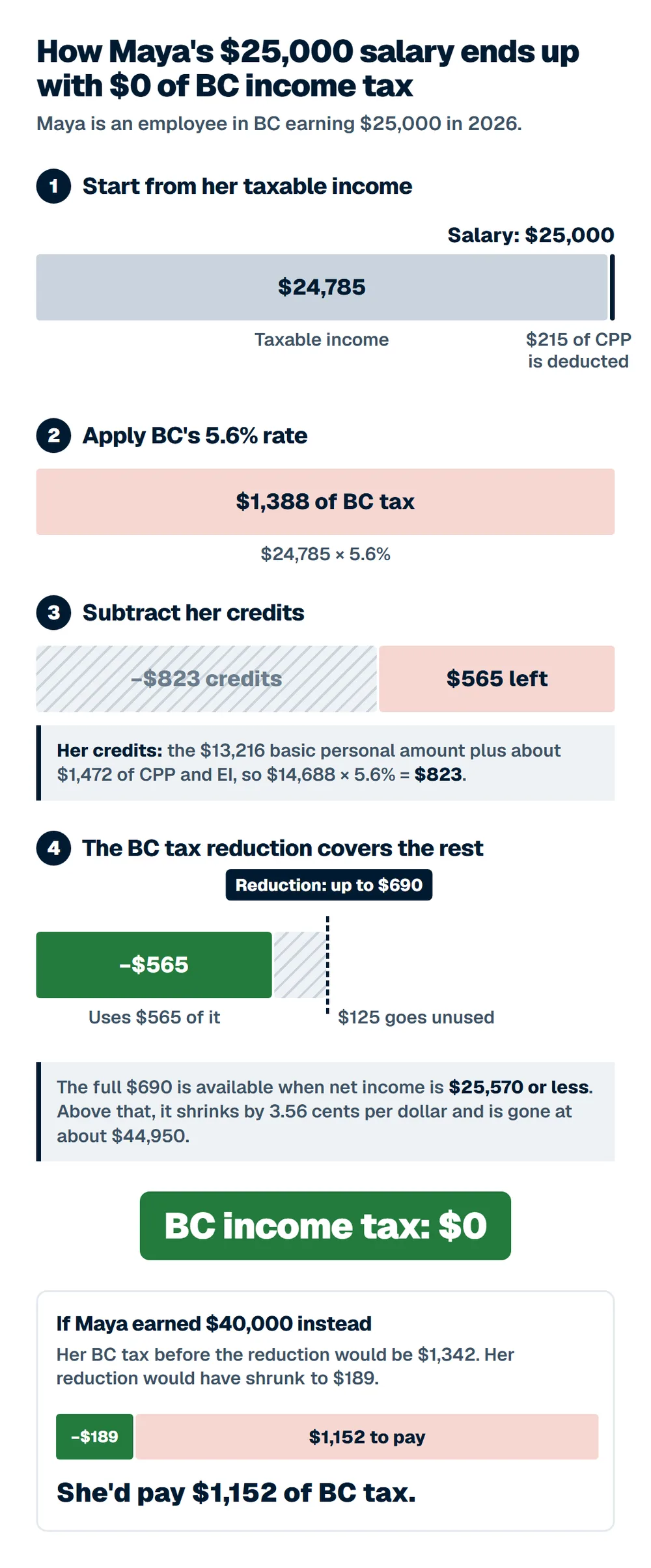
So at $25,000, Maya's only income tax is the $750 she owes the federal government.
Between $30,000 and $45,000, the tax reduction fades out
The BC tax reduction is meant for low incomes, so it shrinks as yours grows. For every dollar of net income above $25,570, it loses 3.56 cents. At $35,570 it's down to $334, and at about $44,950 it's gone. You can watch it fade in the BC tax bill: $282 at $30,000, $717 at $35,000 and $1,152 at $40,000.
While the reduction is fading, BC effectively takes about 9.2% of each extra dollar you earn: its 5.6% tax plus the 3.56 cents of reduction you lose. For a while, that's a bigger share of a raise than BC takes in its next bracket, where the rate is 7.7%. The extra bite stops once the reduction reaches zero.
At $50,000, a higher bracket never costs you money
This is where the brackets come in. BC taxes your first $50,363 of taxable income at 5.6%. Every dollar above that, up to $100,728, is taxed at 7.7%.
Many people worry that moving into a higher bracket will leave them with less, as if the new rate applied to everything they earn. In fact, if your taxable income goes from $50,363 to $50,364, only that last dollar is taxed at 7.7%. Your first $50,363 is taxed exactly as before. The federal brackets work the same way, so a raise always leaves you with more money after income tax. (Benefits that shrink as you earn more are another matter, covered further down.)
At $60,000, two rates go up at once
The first federal bracket ends at $58,523 of taxable income. Above it, the federal rate goes from 14% to 20.5%. BC's rate already went up to 7.7% at $50,363, so a dollar earned between about $58,500 and $100,700 is taxed at both higher rates:
| Government | Rate on your next dollar |
|---|---|
| Federal | 20.5% |
| BC | 7.7% |
| Combined | 28.2% |
That 28.2% is your marginal rate, the tax on your next dollar. What you pay across your whole salary is much lower, because your first dollars were taxed at the lower rates and your credits still apply. At $60,000, federal and BC income tax add up to $7,906, which is 13.2% of your pay. That share is your average rate, and it stays well below the marginal rate at every income.
From $75,000 to $85,000, CPP and EI stop growing
CPP and EI come off every paycheque, but only up to a yearly ceiling. In 2026:
| Contribution | Rate | On earnings | Yearly maximum |
|---|---|---|---|
| CPP | 5.95% | Between $3,500 and $74,600 | $4,230 |
| CPP2, a second tier added in 2024 | 4% | Between $74,600 and $85,000 | $416 |
| EI | 1.63% | Up to $68,900 | $1,123 |
Once you earn $85,000 or more from one employer, you've paid the maximum of all three, about $5,770 for the year. From there, your payroll deductions stop rising even though your income tax keeps going up. It's also why higher earners often see bigger paycheques late in the year: the CPP and EI lines drop to zero once the maximum is reached, then start again in January. Our guide on how to read a Canadian pay stub walks through each line.
At $100,000, how much you actually keep
At $100,000, every piece so far is in play: two sets of brackets, the basic credits, and CPP and EI at their maximum. A year of that salary splits like this:
| Item | Per year |
|---|---|
| Salary | $100,000 |
| Federal income tax | −$13,302 |
| BC income tax | −$5,556 |
| CPP and EI | −$5,770 |
| Take-home pay | $75,373 |
That's about $6,280 a month. Your average income tax rate is 18.9%, while your marginal rate is still 28.2%. The marginal rate is the one to look at when you decide whether to put money in an RRSP.
Money you put in an RRSP comes off your taxable income, so each dollar you contribute saves you tax at your marginal rate. Earn $100,000 and put $5,000 in an RRSP, and your income tax drops from $18,857 to $17,447, a saving of $1,410. You'll pay tax on that money when they take it out, often in retirement at a lower rate. An FHSA, the account for buying a first home, gives the same kind of deduction. A TFSA doesn't, but nothing you take out of it is ever taxed. Our RRSP guide covers the rules and limits.
Above $150,000, more brackets and a smaller federal credit
Above $100,000, both governments keep raising the rate in steps. Here are all the 2026 brackets, applied to taxable income. Federally:
| Federal bracket | Rate |
|---|---|
| Up to $58,523 | 14% |
| $58,523 to $117,045 | 20.5% |
| $117,045 to $181,440 | 26% |
| $181,440 to $258,482 | 29% |
| Over $258,482 | 33% |
And in BC:
| BC bracket | Rate |
|---|---|
| Up to $50,363 | 5.6% |
| $50,363 to $100,728 | 7.7% |
| $100,728 to $115,648 | 10.5% |
| $115,648 to $140,430 | 12.29% |
| $140,430 to $190,405 | 14.7% |
| $190,405 to $265,545 | 16.8% |
| Over $265,545 | 20.5% |
There's one more change that's easy to miss. The federal basic personal amount starts shrinking once your net income passes $181,440, and it bottoms out at $14,829 at $258,482. High earners still get a federal basic credit, just a smaller one. BC's $13,216 amount never shrinks, whatever you earn.
At $150,000, you keep $107,377. At $300,000, you keep $187,450, and your income tax comes to 35.6% of your salary.
At $1 million, the 53.5% top rate covers only part of it
Add BC's top rate of 20.5% to the federal top rate of 33% and you get 53.5%, the number usually quoted for BC's high earners. But it only applies to the part of your income above $265,545. Everything below that still goes through all the lower brackets, and you still get both basic credits.
On a $1 million salary, federal and BC income tax add up to $481,281, about 48.1% of the salary. Add $5,770 of CPP and EI and the take-home pay is $512,950.
What you keep at each salary in BC
| Salary | Income tax | CPP and EI | Take-home pay |
|---|---|---|---|
| $15,000 | $0 | $929 | $14,071 |
| $25,000 | $750 | $1,687 | $22,563 |
| $30,000 | $1,680 | $2,066 | $26,254 |
| $40,000 | $3,844 | $2,824 | $33,333 |
| $50,000 | $5,844 | $3,582 | $40,574 |
| $60,000 | $7,906 | $4,340 | $47,755 |
| $75,000 | $11,920 | $5,370 | $57,711 |
| $85,000 | $14,627 | $5,770 | $64,603 |
| $100,000 | $18,857 | $5,770 | $75,373 |
| $150,000 | $36,854 | $5,770 | $107,377 |
| $300,000 | $106,781 | $5,770 | $187,450 |
| $1,000,000 | $481,281 | $5,770 | $512,950 |
Income tax is federal and BC together, for a single employee in 2026. The figures include the basic personal amounts, the CPP and EI credits, the BC tax reduction and the Canada employment amount, a small federal credit every employee gets on up to $1,501 of pay. They leave out RRSP contributions, union dues, workplace pensions, taxable benefits and any benefits you might receive.
To run your own salary, bonus and pay schedule:
What a $32,000 basic amount would change
The BC Conservatives, who won the October 24 election, promised to raise BC's basic personal amount from $13,216 to $32,000, starting with 2027 taxes. It isn't law yet: the new government still has to pass it. Without it, the amount would stay at $13,216 in 2027, because BC's Budget 2026 froze the yearly inflation increases to its credits from 2027 to 2030. Our look at what the Conservative win means for your money covers the rest of the platform.
Because the basic amount covers everyone's first dollars, not only people who earn less than it, everyone who pays BC tax would save. Using the 2026 rules:
| Salary | BC tax today | With a $32,000 basic amount |
|---|---|---|
| $30,000 | $282 | $0 |
| $40,000 | $1,152 | $101 |
| $60,000 | $2,567 | $1,515 |
| $100,000 | $5,556 | $4,504 |
From about $40,000 up, the saving is the same $1,052 a year: the extra $18,784 of basic amount multiplied by 5.6%. That holds at $1 million too. The party prices the plan at about $2.9 billion a year. For scale, BC's 2023 tax returns show that people earning $250,000 or more, 2% of filers, paid 37% of all BC income tax, while people under $40,000, almost half of filers, paid 1.6%.
Can earning more leave you with less?
Income tax alone can't do it, because a higher bracket only taxes the dollars above its line. But many benefits are paid according to your income and shrink as it rises. So a raise can cost you some benefit on top of the extra tax, which makes its real cost higher than your tax rate. The main ones in BC:
- Canada child benefit. Tax-free monthly payments for children under 18. For July 2026 to June 2027, they start shrinking once your family's net income, yours and your partner's combined, passes $38,237.
- BC family benefit. Paid on top of the Canada child benefit, and also reduced as family income rises.
- Canada Groceries and Essentials Benefit. It replaced the GST/HST credit in July 2026 and pays lower- and modest-income households four times a year. Our guide to the benefit has the amounts and payment dates.
- BC renter's tax credit. Up to $400 a year for renters. For 2026 it starts shrinking once your household's income passes $66,189 and reaches zero at $86,189.
These reductions are gradual, so a raise still leaves you ahead in almost every case. Where it matters most is a family with children near the bottom of these ranges, where the child benefit and the family benefit are both shrinking at the same time as tax goes up. Our Canadian benefits guide lists who qualifies for what.
Why your paycheque doesn't match your final tax bill
Your employer takes an estimate of your income tax off each paycheque. The real amount is settled when you file your return in the spring, using your whole year: a bonus, a second job, an RRSP contribution or a few months without work can all change it. If too much was taken off, you get a refund. That doesn't mean you paid less tax, only that you paid it in advance.
BC's tax rates also changed partway through 2026. Its lowest rate went up from 5.06% to 5.6% for the whole year, but the increase was announced in the February budget and only reached payroll in July. To catch up on the first six months, BC paycheques from July to December 2026 use a temporary rate of 6.14%. Your 2026 return will still use 5.6%, so the two halves of the year should even out when you file.
Bonuses are the other common surprise. Tax on a bonus is often withheld at a higher rate than on regular pay, but the final tax is the same as on any other income. Our guide to tax on a bonus shows how to keep more of it, including by sending it straight to an RRSP.
Page details
- Written by
- Thomas Tremblay
- Last updated
- November 14, 2026
Sources
Sources and verification
Dollar figures are Canooq calculations for a single BC employee using the 2026 federal and BC rules, including the BC tax reduction. The $32,000 basic personal amount is a BC Conservative promise for the 2027 tax year and was not law when this was checked.
- Canada Revenue Agency: Canadian income tax rates for individuals: current and previous yearsfederalChecked 2026-11-14
- Government of British Columbia: British Columbia personal income tax ratesprovincialChecked 2026-11-14
- Government of British Columbia: B.C. basic personal income tax creditsprovincialChecked 2026-11-14
- Canada Revenue Agency: Payroll Deductions Tables T4032BC, July 2026: general informationfederalChecked 2026-11-14
- Canada Revenue Agency: Indexation adjustment for personal income tax and benefit amountsfederalChecked 2026-11-14
- Government of British Columbia: B.C. renter's tax creditprovincialChecked 2026-11-14
- Canada Revenue Agency: Canada child benefit: how much you can getfederalChecked 2026-11-14
- Canada Revenue Agency: RC4210, Canada Groceries and Essentials BenefitfederalChecked 2026-11-14
- Government of British Columbia: B.C. family benefitprovincialChecked 2026-11-14
- Canada Revenue Agency: Individual Income Tax Return Statistics (2023 tax year), Table 2: British ColumbiafederalChecked 2026-11-14
Cite this page: Canooq.ca, How BC income tax works in 2026, from $0 to $1 million, https://www.canooq.ca/blog/bc-income-tax-2026-0-to-1-million
Canooq content is educational and may include affiliate or referral links. It is not financial, tax, legal, immigration, employment, mortgage, real estate, or healthcare advice. Verify official sources and provider terms before acting.