Wine Touring Without Driving: How to Taste Properly in Canada's Wine Regions

August 25, 2026
How to visit Canadian wineries without a designated driver, using bikes, seasonal winery buses, shuttles and the walkable clusters in each region.

What's on this page
Every Canadian wine region has a car-free option and almost nobody writes about them. Naramata has a rail trail with wineries along it, Niagara-on-the-Lake is flat and cyclable, Prince Edward County has shuttles and a compact Wellington cluster, and Wolfville runs a double-decker winery bus in season.
The standard Canadian winery day has a flaw built into it. Somebody has to drive, which means somebody spends the day holding a glass they are not drinking, and the tasting notes at the fourth stop are being written by the only person not enjoying themselves.
Every major Canadian wine region has a way around this. Not one of them is well advertised, because wineries assume you arrived by car. Here is what actually exists.
Okanagan: the rail trail does the work
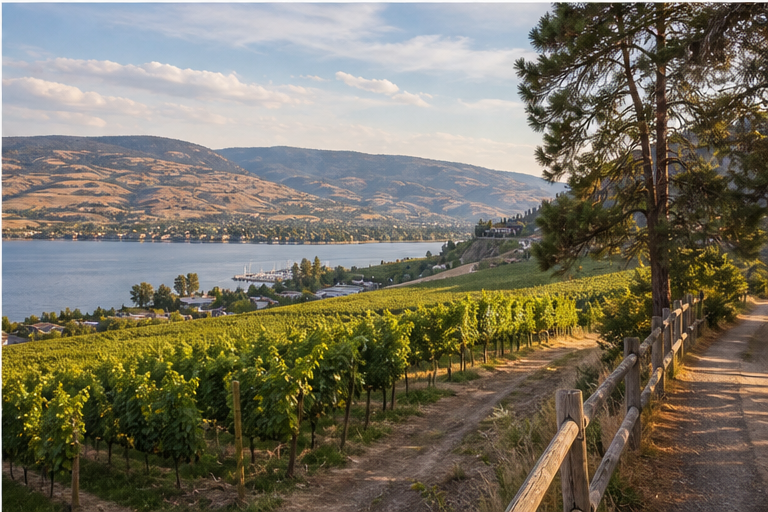
The Naramata Bench, north of Penticton, is a strip of vineyards on a slope above Okanagan Lake, and the old Kettle Valley Railway grade runs through the middle of it. The grade is gentle by design, since it was built for trains, and a string of wineries sit within a short push of the trail.
That makes cycling the obvious approach: rent in Penticton, ride north, stop at three or four, and roll back. Add e-bikes if the group has mixed fitness. Shuttle and tour operators in Penticton cover the same route for anyone who does not want to pedal at all, and the town itself is walkable with tasting rooms in it.
Our Kettle Valley Rail Trail guide covers the trail in detail, and the Okanagan wine weekend guide covers the wider region including the Golden Mile and Oliver, which are harder to do without a car.
Niagara: flat, close together and made for bikes
Niagara-on-the-Lake has the highest density of wineries in Ontario, the land is flat, and the distances between properties are short. Rentals are available in town, several wineries have bike racks and a few actively cater to arriving cyclists.
The Niagara River Recreation Trail runs along the parkway and connects the town to the falls, which means you can arrive by GO train or VIA to Niagara Falls, take a local bus or ride the trail into Niagara-on-the-Lake, and never touch a car. Tour operators also run from both Toronto and the Niagara Falls hotels.
The Twenty Valley wineries around Jordan and Beamsville are a different proposition, with longer distances and hills. Those need a shuttle or a tour.
Prince Edward County: shuttles and one walkable village
The County is spread out, and its wineries are separated by enough distance that cycling between all of them is a full day of riding rather than a wine day. The workaround is Wellington, where several tasting rooms sit within a short walk of each other, plus a shuttle for the rest.
Local operators run scheduled and private tours in the summer season, and accommodation in Picton, Bloomfield and Wellington puts you inside the area rather than driving in from Belleville. This is the region where booking transport in advance matters most, since capacity is genuinely limited on summer weekends.
Nova Scotia: an actual winery bus
Wolfville, in the Annapolis Valley, runs a seasonal double-decker bus that loops between wineries on a hop-on basis. It is the most straightforward car-free wine day in the country: buy a ticket, get on, get off where you like, get back on.
The town is compact enough to stay in and walk around afterwards, and the wines are worth the trip in their own right, particularly the province's appellation white. It runs in the warm season only.
Quebec and the Eastern Townships
The Route des vins in Brome-Missisquoi threads through Dunham, Frelighsburg and the surrounding hills, and it is beautiful country to cycle if you are fit, since it is not flat. La Route Verte cycling network connects parts of it.
For most visitors the practical answer is a tour from Montreal or an overnight in Dunham or Sutton with a local driver for the day. The compensation is that the Townships pair wine with cider, cheese and a Nordic spa within the same 30 kilometres.
Car-free wine options by region
Seasonal services vary year to year. Confirm operation before booking travel.
| Region | Best car-free method | Season | Base town |
|---|---|---|---|
| Naramata Bench | Bike on the rail trail, or a shuttle | May to October | Penticton |
| Niagara-on-the-Lake | Bike, or transit from Niagara Falls | May to October | Niagara-on-the-Lake |
| Prince Edward County | Shuttle plus walkable Wellington | June to October | Wellington or Picton |
| Annapolis Valley | Seasonal winery bus | Summer to early autumn | Wolfville |
| Brome-Missisquoi | Tour from Montreal, or cycling | May to October | Dunham or Sutton |
The four ways to do it, ranked
A hop-on winery bus is the best of them where one exists, because it removes every decision except which stop to get off at. A private driver for a group of four or six is the next best and often costs less per person than people assume once a scheduled tour is priced out.
Cycling is the most enjoyable and the most limited, since it only works where the terrain is flat or the grade is a converted railway, and it caps how much you can buy. Staying somewhere walkable is the quiet winner: Wellington, Wolfville, downtown Penticton and Niagara-on-the-Lake all have enough within a few blocks to fill an afternoon without transport at all.
Practical rules that make it work
- Book the transport before the wineries. Shuttle capacity is the constraint, not tasting room space.
- Three or four stops, maximum. Five is where a wine day becomes a drinking day and the wine stops registering.
- Eat at the second stop. Most regions have at least one winery restaurant, and lunch in the middle changes the whole day.
- Ask about shipping. Most wineries ship within a province, and some across provinces, which solves the problem of carrying six bottles on a bike.
Interprovincial wine shipping rules differ by province and have changed several times, so ask at the winery rather than assuming. For park stops on the same trip, the Pass and Parking Checker covers access rules, and the Experience Finder filters Canooq guides by starting city and travel style, including car-free options.
Plan the rest of the trip
Car-free wine days depend on seasonal services, so confirm what is running before you book a room.
Common questions
Can you bike between wineries in the Okanagan?
Yes, particularly on the Naramata Bench where the Kettle Valley Rail Trail runs past several properties on a gentle grade.
Is there a winery bus in Niagara?
Tour operators run scheduled and private winery tours from Niagara Falls and Toronto, and Niagara-on-the-Lake is compact enough to cycle between properties.
What is the easiest Canadian wine region without a car?
Wolfville in Nova Scotia during the winery bus season, followed by Naramata by bike and Niagara-on-the-Lake on foot and by bike.
Can wineries ship bottles home?
Usually within the same province, and sometimes across provinces depending on current rules. Ask at the tasting room before you carry anything.
Sources
Related travel guides:
Page details
Author: Thomas Tremblay
Updated: August 13, 2026
Last reviewed: August 13, 2026
Sources verified: August 13, 2026
Cite this page: Canooq.ca, Wine Touring Without Driving: How to Taste Properly in Canada's Wine Regions, https://www.canooq.ca/travel/wine-touring-without-driving-canada
Canooq content is educational and may include affiliate or referral links. It is not financial, tax, legal, immigration, employment, mortgage, real estate, or healthcare advice. Verify official sources and provider terms before acting.
Enjoy Canooq? Let us keep helping you — make Canooq a preferred source on Google.